Pennsylvania has a way of making you feel small—in the best possible way.
One moment you’re standing on solid ground, the next it feels like the world drops away beneath your feet.
Mountains rise like giants. Rivers carve deep scars through the earth.
Even silence feels enormous here.
Step into these places and something shifts. Worries fade.
Distance stretches. The sky seems closer, and everything else feels far, far away.
This is a collection of twelve Pennsylvania spots where scale takes over, and everyday life gets swallowed by something much bigger.
Delaware Water Gap National Recreation Area
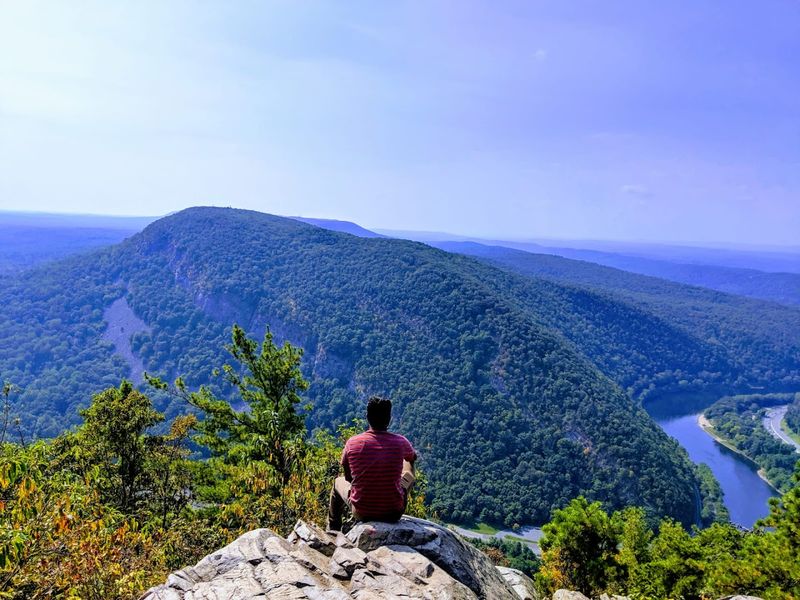
The Delaware River slices straight through ancient Appalachian rock here, creating a natural gateway that feels like entering another dimension. As you hike the ridgelines, the horizon refuses to end.
Mountain layers fade into misty blue distance while the river below traces its silver path through the gap.
Over 70,000 acres spread across this protected wonderland, offering hundreds of trails and overlooks. Each vantage point reveals something different.
Some mornings, fog fills the valleys like an ocean, leaving only mountaintops floating above the clouds.
Rock climbers scale the sheer cliffs of Mount Tammany while kayakers drift through calm river sections flanked by forest walls. The sheer scale becomes obvious when you realize tiny dots moving along distant ridges are actually groups of hikers.
This place doesn’t just offer views; it recalibrates your sense of space.
Whether you visit during autumn’s fiery display or summer’s green abundance, the vastness stays constant. Stand anywhere along these ridges and your problems suddenly occupy much less mental real estate.
Pine Creek Gorge
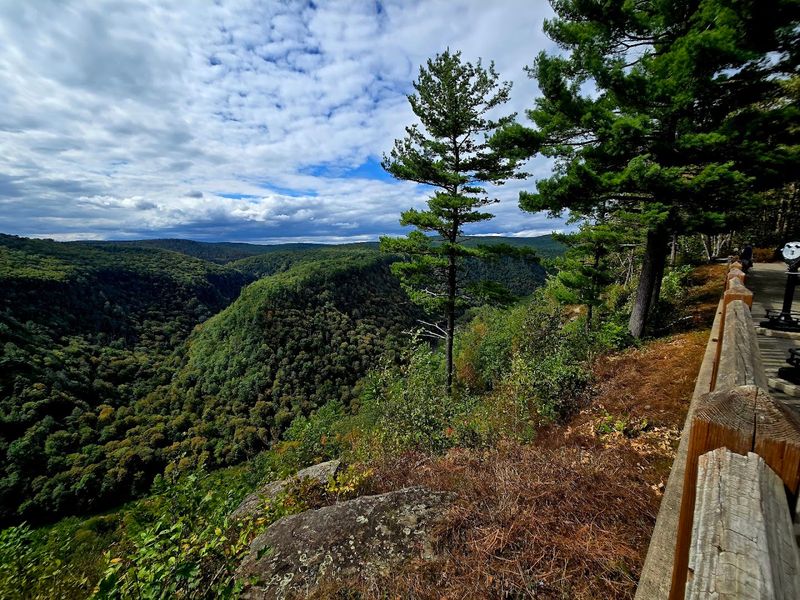
Imagine standing at the edge of Pennsylvania’s answer to the Grand Canyon. Pine Creek Gorge plunges 800 feet below your feet while stretching nearly 50 miles into the distance.
The scale hits you immediately—this isn’t just a valley, it’s a monument carved by water and time.
The gorge earned its “Grand Canyon of Pennsylvania” nickname honestly. Dense forests blanket both sides, creating an unbroken green carpet that rolls into hazy distance.
Pine Creek itself appears as a silver thread far below, barely visible through the canopy.
Two rail trails run along the gorge bottom, letting you experience the canyon from inside its depths. Down there, the walls tower overhead, flipping your perspective completely.
What looked small from above becomes massive when you’re beneath it.
Fall transforms this place into something from a painting—reds, oranges, and golds explode across the slopes. Eagles soar at eye level when you’re standing on the rim.
The gorge reminds you that Pennsylvania wilderness runs deeper and wider than most people imagine.
Leonard Harrison State Park
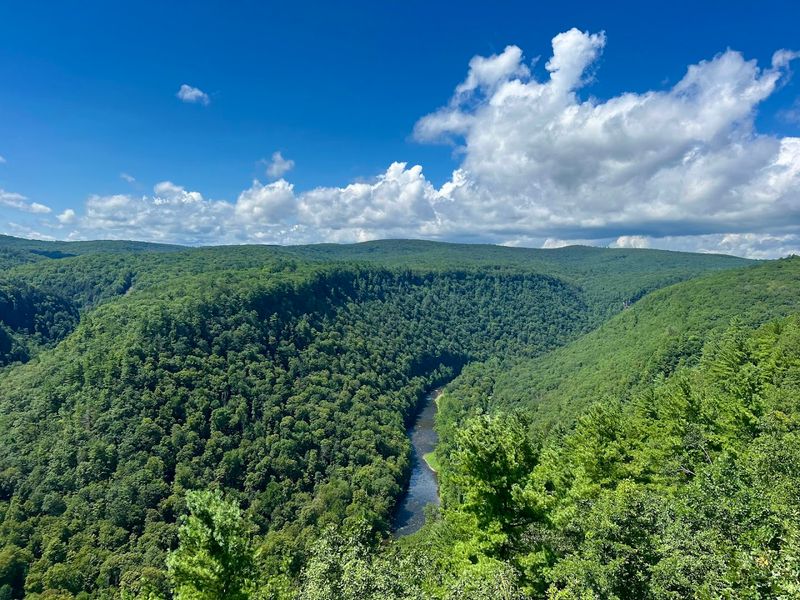
Perched 800 feet above Pine Creek, Leonard Harrison delivers what might be Pennsylvania’s most photographed view. The observation deck juts out over empty air, placing nothing between you and the gorge except space and possibility.
Your eyes travel for miles before meeting anything solid.
Peak fall foliage season turns this overlook into something almost unreal. The valley floor erupts in color while morning mist adds mystery to the distant bends.
Photographers arrive before sunrise, knowing the light show will be worth the early alarm.
Turkey Path Trail descends from the rim if you’re feeling adventurous. The steep scramble drops you 600 feet through rock outcrops and old-growth forest.
Returning means climbing back up, which makes you truly appreciate the vertical scale you’re dealing with.
Families gather along the overlook railing while hawks ride thermals below. Yes, below—you’re standing high enough that birds fly beneath you.
Kids press against the fence, counting the layers of ridges marching toward the horizon. The vastness sinks in slowly, like your brain needs time to process what your eyes are showing it.
Hawk Mountain Sanctuary
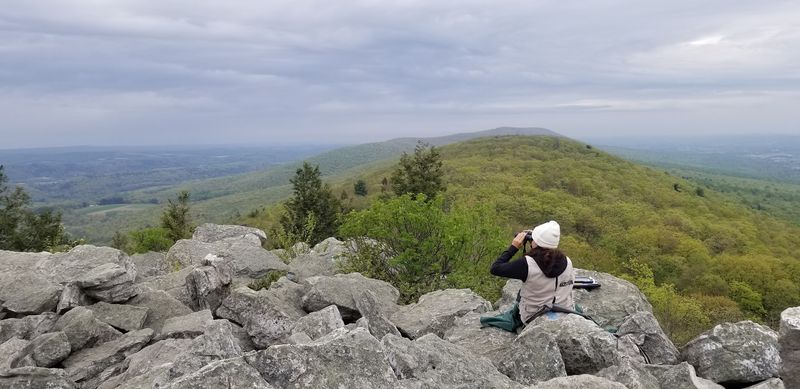
Every autumn, something magical happens along this Appalachian ridgeline. Thousands of raptors funnel through on their southern migration, riding invisible wind currents that humans can’t see but birds navigate expertly.
Standing on North Lookout, you’re surrounded by sky in every direction.
The sanctuary sits atop a natural flyway where updrafts make soaring effortless for hawks, eagles, and falcons. Mountain ridges stack up like ocean waves extending to every horizon.
Some days you can count seven different layers fading into atmospheric blue.
Volunteers with spotting scopes help identify birds appearing as distant specks. Suddenly a speck transforms into a golden eagle, and you realize you’re watching one of nature’s most impressive travelers.
The sky becomes alive with movement and purpose.
Even without birds, the view justifies the visit. The Kittatinny Ridge stretches endlessly northeast and southwest, showing you Pennsylvania’s backbone.
Wind rushes up the slope constantly, bringing the scent of distant forests. Here, you understand how small pieces fit into much larger systems—both for birds and yourself.
Ohiopyle State Park
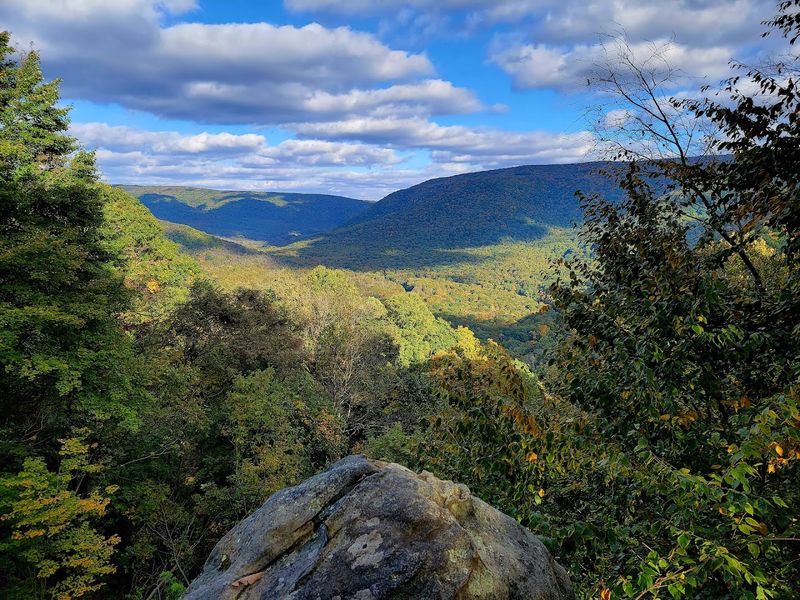
The Youghiogheny River crashes through this park with serious attitude. Ohiopyle Falls roars at the town center, but the real drama happens downstream where the river carves through steep-walled gorges that make rafters feel tiny against the landscape’s power.
Over 20,000 acres of wilderness spread across mountains and valleys here. The Lower Gorge section drops rafters through class III and IV rapids between forest walls that block out everything except sky directly overhead.
You’re in Pennsylvania’s wilderness, not just looking at it.
Cucumber Falls adds another dimension—a 30-foot waterfall tucked into a hemlock-shaded amphitheater. The contrast between the falls’ gentle cascade and the river’s aggressive whitewater shows nature’s range.
Both make you feel small but in completely different ways.
Mountain bike trails wind through sections where the forest seems to extend forever. Climbing to Sugarloaf Knob or Baughman Rock rewards you with overlooks revealing just how much wild land surrounds you.
The park operates on a scale that makes day trips feel like expeditions into genuine backcountry.
Ricketts Glen State Park
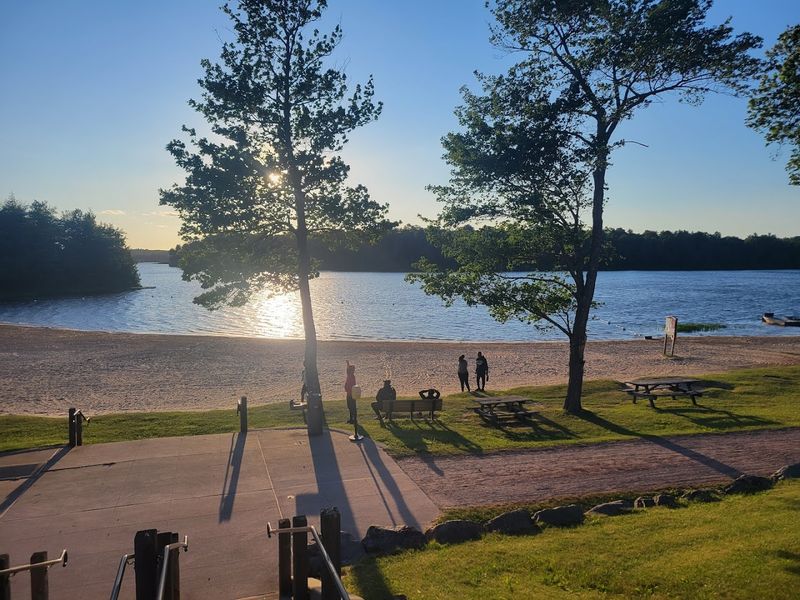
Twenty-two named waterfalls tumble through Ricketts Glen, but numbers don’t capture the feeling of walking through a forest that remembers centuries. Ancient hemlocks tower overhead, their trunks thick enough that three people can’t reach around them.
The wilderness feels primordial and endless.
The Falls Trail makes a seven-mile loop that’s really a journey backward through time. Each waterfall has personality—some thunder dramatically while others whisper over mossy rocks.
Ganoga Falls, the tallest at 94 feet, demands you stop and stare as water explodes into mist and rainbows.
Steep terrain means this hike earns its reputation as challenging. The trail climbs, descends, and crosses streams on stone pathways that can get slippery.
But the effort creates intimacy with the landscape that easy walks never achieve.
The old-growth forest stretches across ravines and ridges that seem to continue forever. Standing beside these massive trees while waterfalls echo through the glen makes modern life feel very recent and very small.
This is what Pennsylvania looked like before cities—wild, vertical, and utterly unconcerned with human schedules.
Cherry Springs State Park
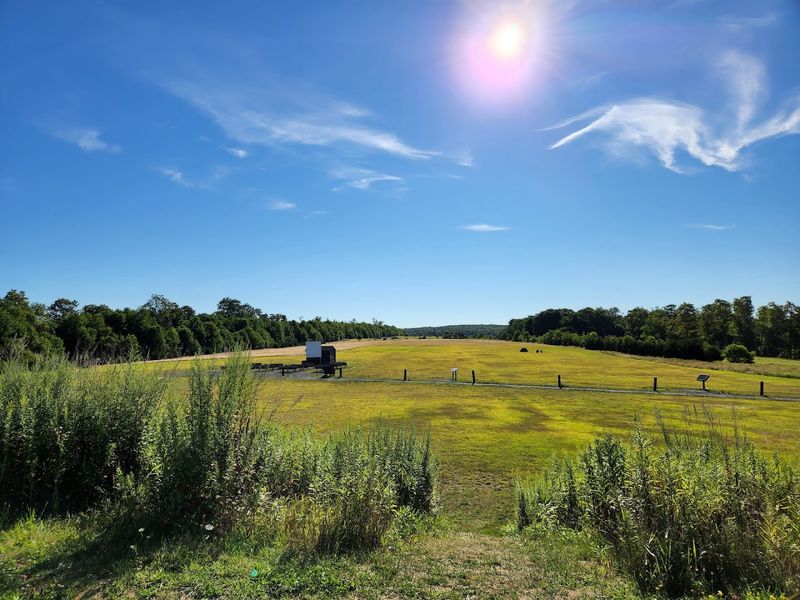
Wait until after sunset, and Cherry Springs reveals its true magic. As darkness deepens, stars emerge—not just a few, but thousands upon thousands until the sky becomes more light than darkness.
The Milky Way stretches overhead like a cosmic river, and suddenly Earth’s place in the universe becomes beautifully, terrifyingly clear.
This park earned Gold Tier designation as an International Dark Sky Park, meaning almost zero light pollution reaches it. On moonless nights, the universe puts on shows that most Americans never see.
Galaxies, nebulae, and star clusters that require telescopes elsewhere appear naked-eye visible here.
Astronomers travel hundreds of miles to Cherry Springs, setting up serious equipment across the viewing fields. But you don’t need fancy gear.
Just lie back and let your eyes adjust. Within twenty minutes, you’ll see more stars than you knew existed.
The experience expands your worldview literally and figuratively. You’re not just seeing distant suns—you’re witnessing photons that traveled for years or centuries to reach your eyes.
The forest horizon frames infinity above, making you feel simultaneously tiny and connected to everything.
Kinzua Bridge State Park
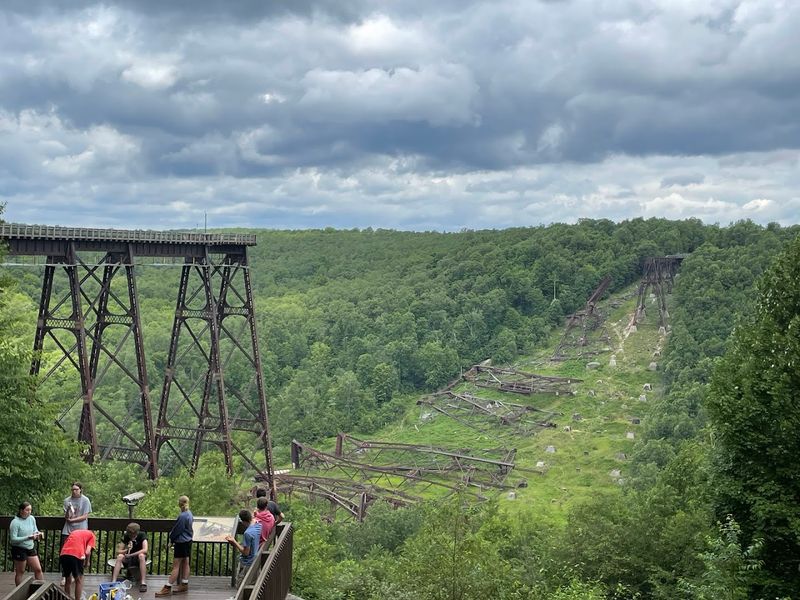
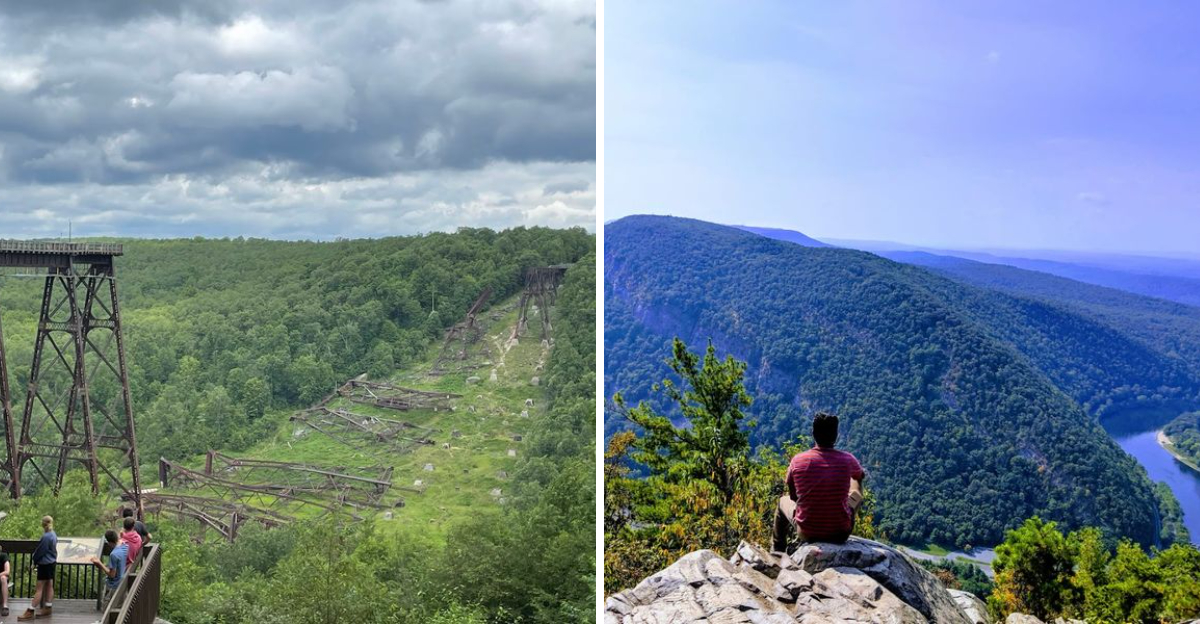
The Sky Walk extends 624 feet into thin air, ending where the historic railroad bridge once continued. Now it stops abruptly, leaving you suspended above a 300-foot drop with nothing but forest valley spread out below.
The view creates that stomach-dropping sensation of height combined with openness.
This former railroad viaduct stood as an engineering marvel until a tornado partially destroyed it in 2003. Instead of rebuilding, Pennsylvania created something better—a glass-bottomed observation deck that lets you look straight down through transparent panels.
Looking through that glass makes your brain argue with your feet.
The valley stretches away in every direction, showing forests and sky merging at distant horizons. Kinzua Creek appears as a silver thread far below.
The sheer drop emphasizes how high you’re standing and how much empty space exists between you and solid ground.
Visitor center exhibits explain the bridge’s history while trails loop through the surrounding forest. But everyone comes for that moment on the Sky Walk where solid railings feel like the only things connecting you to reality.
The openness challenges your comfort zone in the best possible way.
Presque Isle State Park
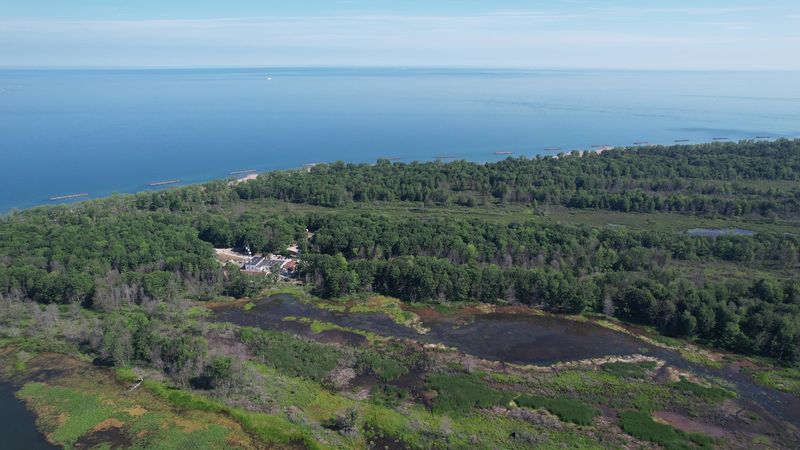
Step onto Presque Isle’s beaches and Pennsylvania suddenly feels like it borders an ocean. Lake Erie stretches to the horizon without a single opposite shore visible.
The water meets sky in a perfectly level line that could be anywhere coastal, except you’re standing in the Great Lakes region.
This seven-mile sandy peninsula curves into Lake Erie like a natural breakwater. Beaches on one side face endless open water while the bay side offers calmer, protected waters.
Walking between them shows how the same peninsula can create completely different moods.
Thirteen miles of trails wind through diverse ecosystems—beaches, marshes, forests, and dunes all packed onto one narrow landform. But the water dominates everything.
Stand anywhere, and water surrounds you in three directions, making the peninsula feel like an island untethered from mainland Pennsylvania.
Summer brings crowds enjoying what feels like proper seaside atmosphere—lifeguards, beach volleyball, people swimming in genuine surf. Winter transforms the shore into something otherworldly when ice formations build along the waterline.
Year-round, the horizon’s openness makes you forget you’re landlocked. The scale of Lake Erie humbles you quietly.
Hyner View State Park
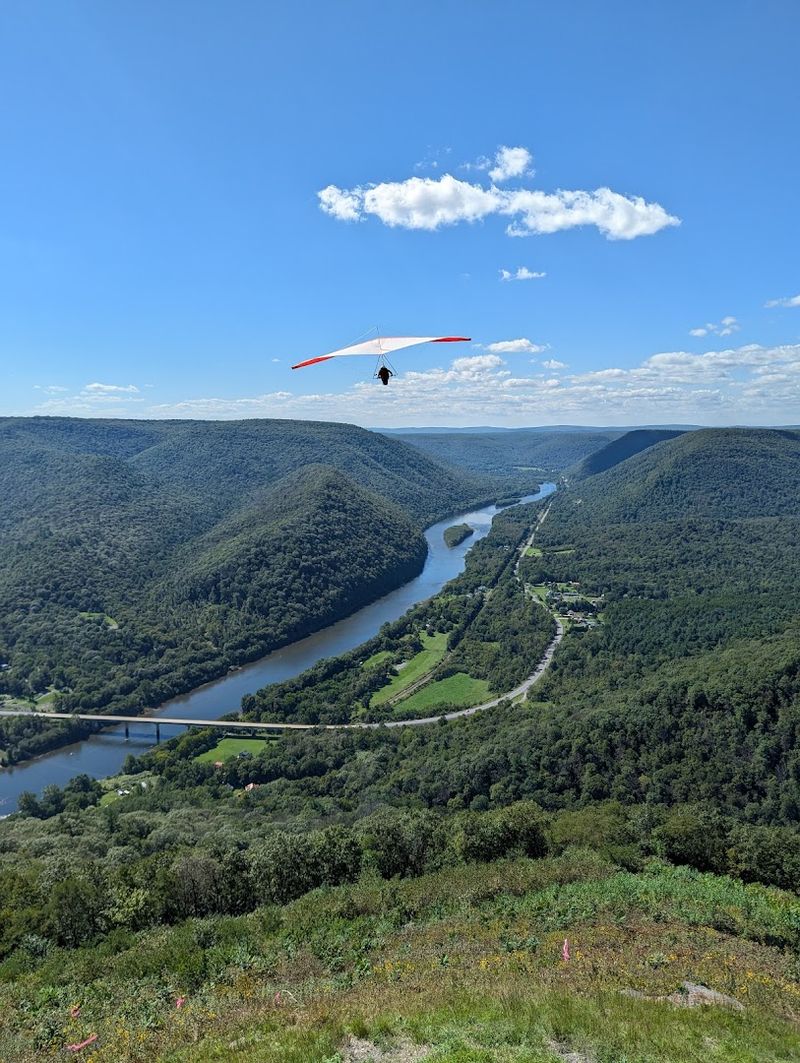
Hang gliders launching from Hyner View appear to float motionless against the valley backdrop before catching thermals that lift them higher. Watching them, you understand why pilots drive hours for this launch point.
The Susquehanna River valley spreads 1,300 feet below, offering the kind of expansive view that makes flying seem reasonable.
The overlook sits atop a cliff that drops away sharply, creating an unobstructed view that sweeps across miles of valley floor. The West Branch Susquehanna snakes through farmland and forest patches that look like quilted patterns from this height.
Ridge after ridge marches into blue distance.
You don’t need to fly to appreciate the scale. Just standing at the railing delivers that edge-of-the-world sensation.
Hawks circle at eye level, riding the same updrafts that hang gliders use. The wind rushing up the cliff face brings that high-altitude freshness that only exists where land meets open sky.
Sunset turns this spot magical—the valley fills with golden light while shadows creep across distant ridges. Photographers compete for rail space while hang gliders pack up after their final flights.
The vastness lingers in your mind long after you’ve driven back down the mountain.
Mount Davis
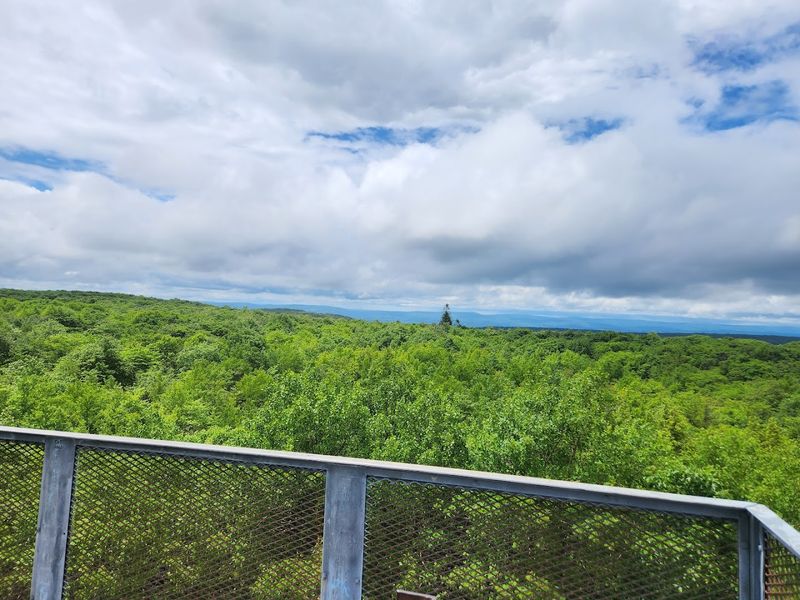
At 3,213 feet, Mount Davis claims the title of Pennsylvania’s highest natural point. The distinction might sound modest compared to Western peaks, but standing here reveals something unexpected—how elevation changes perspective even without dramatic cliffsides.
The surrounding ridges roll away like frozen waves toward every compass point.
A stone observation tower adds extra height, boosting your vantage point above the tree canopy. From the tower, forested mountains extend in every direction without visible end.
No cities, no major roads, just tree-covered ridges fading through shades of blue until atmosphere obscures them completely.
The summit’s quietness adds to its impact. No crowds gather here despite the superlative elevation.
Wind whispers through the trees while birds call from the forest. The solitude lets you absorb the view without distraction.
Laurel Highlands Trail passes near the summit, connecting this high point to miles of backcountry. Knowing that wilderness extends beyond your sight line makes the view feel even more significant.
You’re not looking at Pennsylvania’s highest point—you’re standing on top of Pennsylvania itself, seeing the state’s true extent laid out like a relief map.
Gettysburg National Military Park
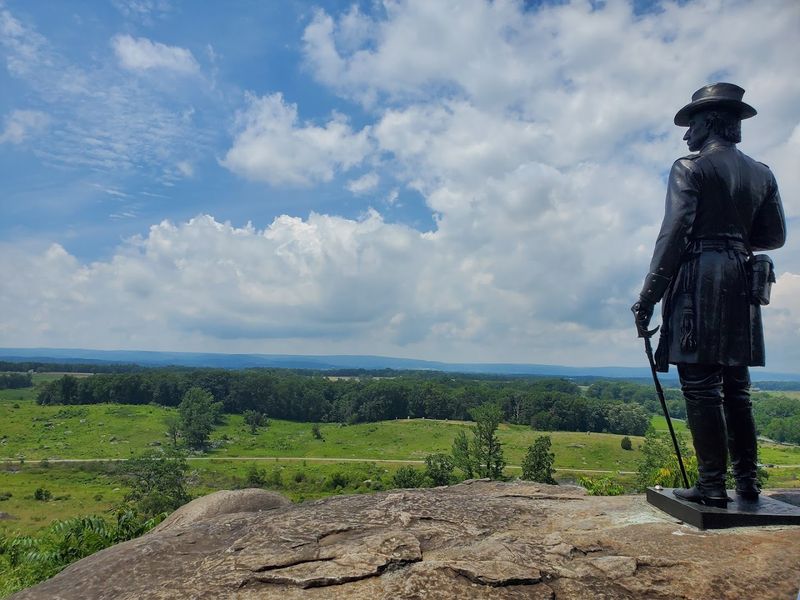
History hangs thick over Gettysburg’s fields, but the landscape itself tells a powerful story. These open expanses—farmland where armies clashed in 1863—stretch between ridgelines that seem deceptively close until you try walking between them.
The space amplifies everything that happened here.
Standing at Little Round Top, you can see Devil’s Den, the Wheatfield, and Peach Orchard spread across the valley. The distances that soldiers covered under fire become real when you trace those routes with your eyes.
The openness that made these fields strategic battleground also makes them feel vast and exposed.
Over 1,300 monuments dot the battlefield, but they don’t crowd the space. Instead, they punctuate the openness, marking specific positions across miles of preserved land.
The scale of the battlefield reflects the scale of what happened—over 50,000 casualties across three days in a relatively small geographic area.
Visit at sunrise when mist fills the valleys and the fields feel ancient. The distant ridgelines frame the horizon while cannons and monuments stand as silent sentinels.
The landscape’s openness creates a sense of exposure and vulnerability that helps you grasp the enormity of the battle beyond any textbook description.