If you have ever wished you could walk straight into an untouched 19th-century world, Old Economy Village gets startlingly close. This is not a recreated streetscape or a themed interpretation, but a real village built by the Harmonists and still standing in remarkable form.
In Ambridge, Pennsylvania, quiet brick buildings, workshops, and gardens hold the story of a religious community that tried to build heaven on earth through order, labor, and faith. The deeper you look, the stranger and more human it becomes.
The Town That Time Kept Intact
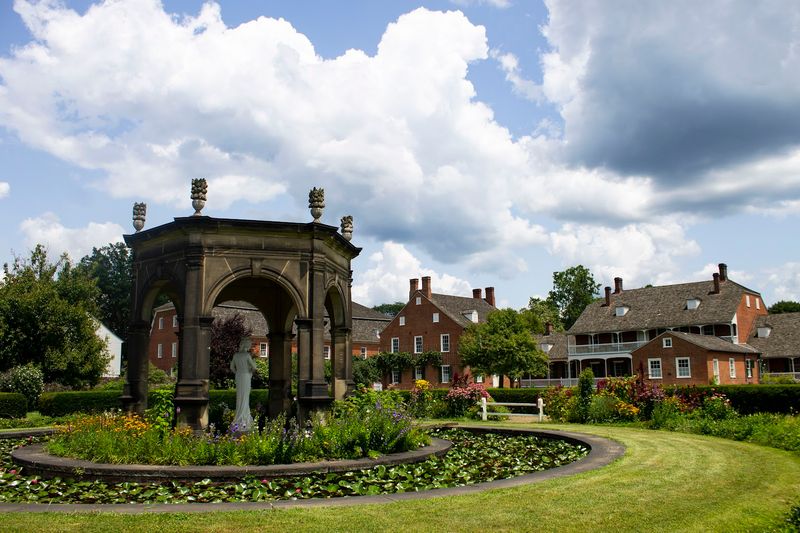
The first surprise at Old Economy Village is how little explaining your eyes need. You are not looking at a replica village assembled later for tourists, but at the actual core of a 19th-century utopian settlement built by the Harmonists and preserved where it stood.
That fact gives the place an unusual weight, because every wall feels less interpreted than inherited.
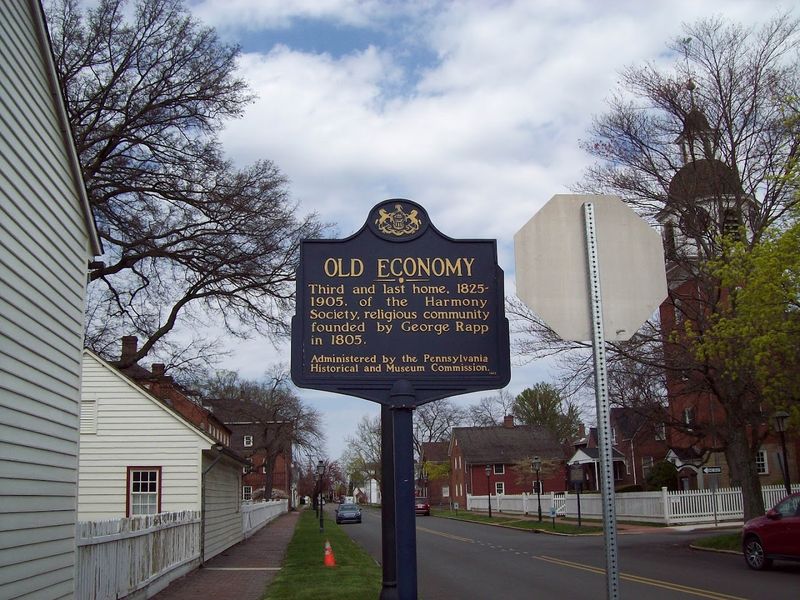
Seventeen original buildings survive on the site, including homes, workshops, a church, and the famous garden, all maintained today as a Pennsylvania state historic site. The village is also part of a National Historic Landmark District, which helps explain why the setting still feels coherent instead of scattered.
Walking here, you sense a whole social system still visible in brick, pathways, and room layouts.
What stays with you most is the intactness. Old Economy does not just preserve objects from the past – it preserves the bones of an idea, still standing almost exactly where its believers left it behind.
Ambridge’s Double Identity
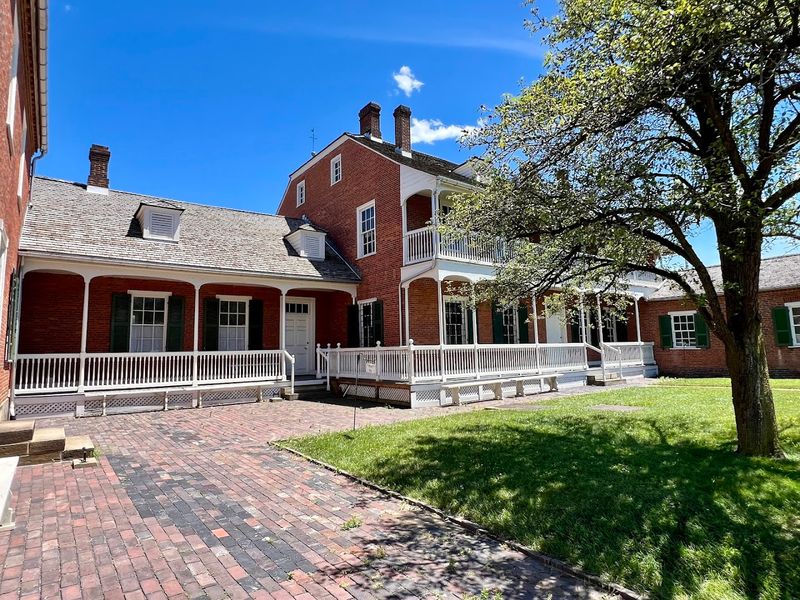
Ambridge looks like a western Pennsylvania river town, but its map hides an older story underneath. Sitting along the Ohio River in Beaver County, about 16 to 17 miles northwest of Pittsburgh, it developed one identity after another, first as a religious communal settlement and later as an industrial borough.
Even the name Ambridge points to that second life, drawn from the American Bridge Company.
That company bought the land after the Harmony Society dissolved and helped transform the area into a working industrial center in 1905. What makes the place so interesting is that the modern town did not erase the old village cleanly.
Instead, parts of Ambridge were laid over the Harmonist settlement, so the communal past is physically embedded beneath later streets and routines.
I think that layering changes how you read the town. Old Economy Village is not isolated from Ambridge’s story – it is the foundation under it, a spiritual blueprint covered by steel-town history.
Who the Harmonists Were
The people who built Economy were known as the Harmonists, or the Harmony Society, a German religious group led by Johann Georg Rapp, usually called George Rapp in the United States. They came from Württemberg in the early 1800s seeking relief from religious persecution and hoping to live according to a stricter spiritual vision.
Their beliefs were intense, but their organization was practical, disciplined, and highly skilled.
They shared property, worked communally, and arranged daily life around devotion, labor, and preparation for Christ’s return. One of their most defining choices was celibacy, embraced as a religious discipline meant to purify the community for the Millennium.
That made the Society unusual from the start, because it could not replenish itself through children and depended entirely on attracting converts.
They built three settlements in America before establishing Economy as their final home. What fascinates me is the combination of mystical expectation and hardheaded competence – visionary people who could also lay bricks, manage industries, and keep excellent records.
How They Built Economy So Fast
When the Harmonists arrived at the site of Economy in 1824, they did not improvise. They planned a village organized for work, worship, and efficiency, centering major structures around the church and the homes of George Rapp and Frederick Rapp.
In roughly 18 months, they constructed about 200 buildings, an astonishing pace that says as much about discipline as it does about manpower.
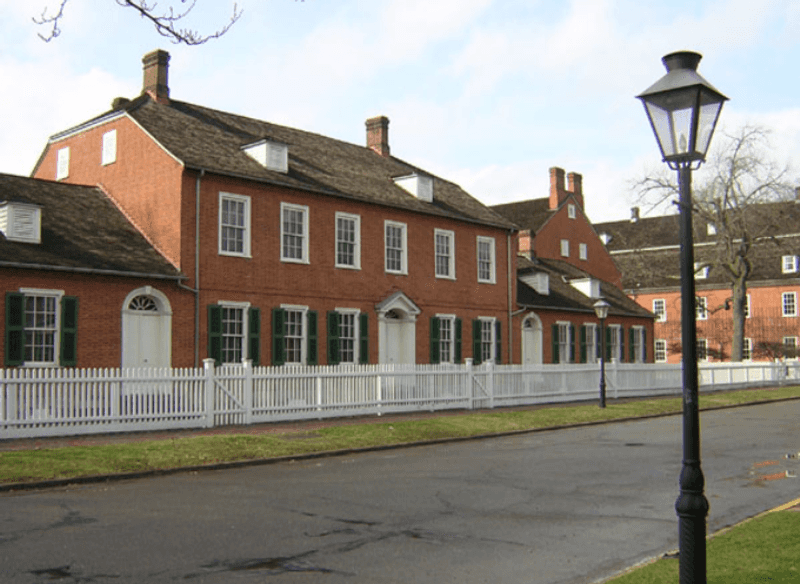
Their methods were rooted in German craft traditions and adapted to local materials, especially brick and timber. The result was architecture that feels plain but deliberate: balanced proportions, solid walls, practical interiors, and layouts made for long use rather than display.
They brought the same standards to industry, producing wool, cotton, silk textiles, wine, whiskey, and lumber, while also operating a sawmill, tannery, and distillery.
You can feel that work ethic in the surviving buildings. They were not built as monuments, yet many outlived flashier structures because the Harmonists treated construction as a moral act – careful, useful, and meant to endure.
Daily Life in a Controlled Paradise
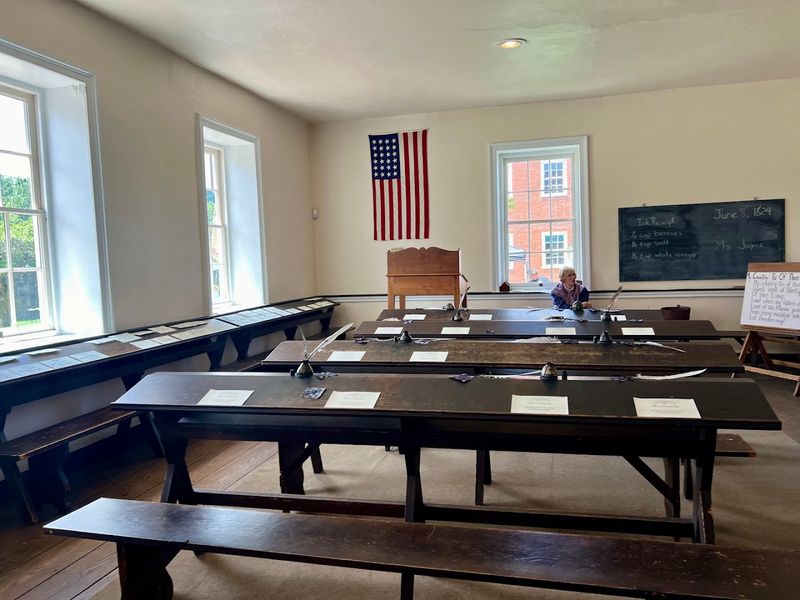
Life inside Economy was communal in the fullest sense, and that meant both comfort and control. Members signed over their personal property when they joined, and in return the Society provided housing, food, education, medical care, and a place within the community’s tightly organized rhythm.
It was a genuine support system, but one built on surrendering individual ownership and much of individual choice.
Residents worked assigned trades for the common good, dressed simply, and ordered their days around religious observance and productive labor. Meals were shared, resources pooled, and tasks distributed according to the needs of the whole.
From the outside, it may sound austere, yet there was also security in knowing your livelihood, healthcare, and daily needs were collectively managed.
What I find most revealing is how normal this probably felt to those inside it. Utopia here was not constant ecstasy – it was routine, discipline, and the belief that ordinary work, done together, could prepare a community for something holy.
George Rapp’s Garden Still Breathing
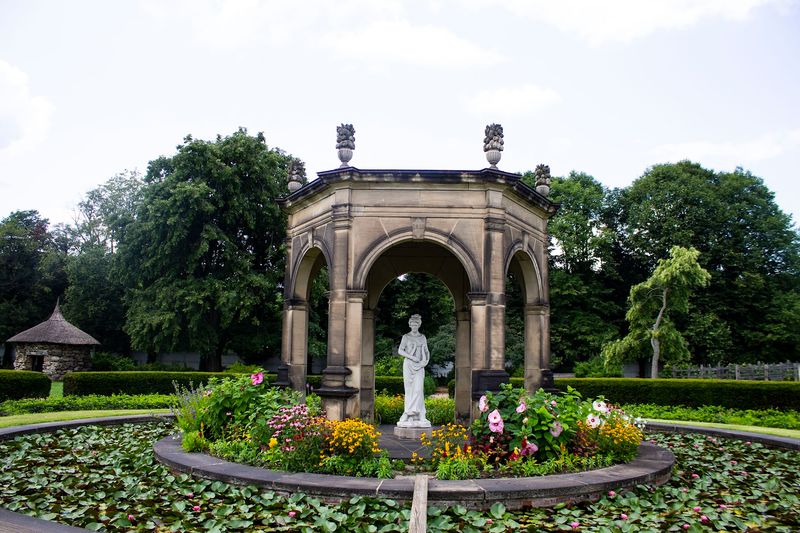
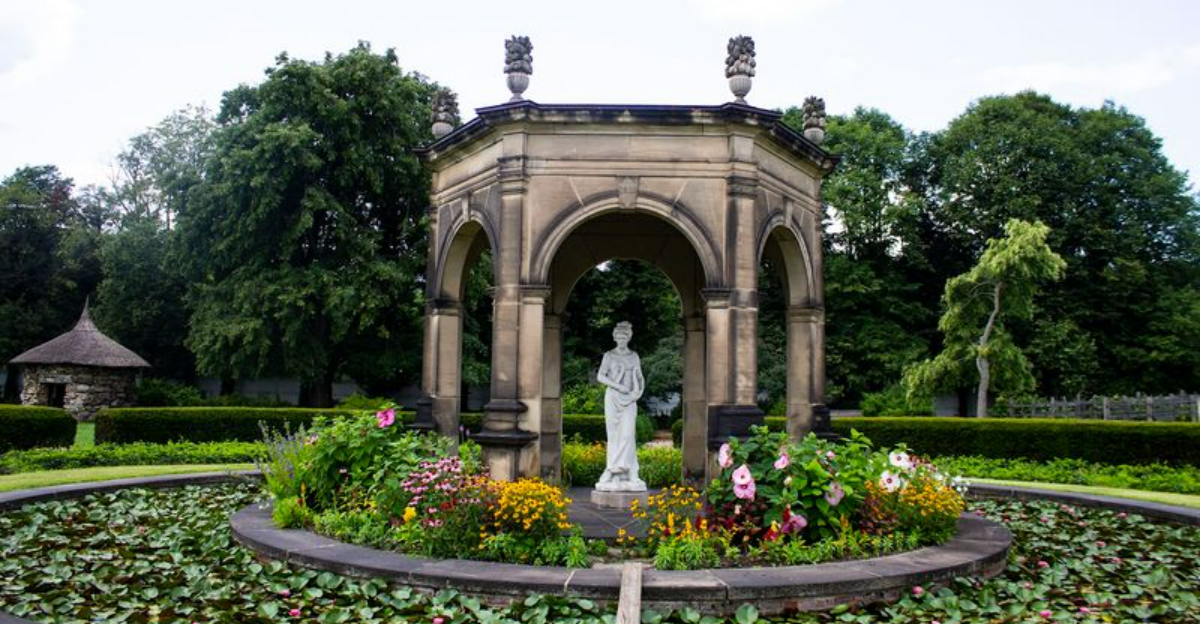
George Rapp’s Garden is one of those places that lowers the volume in your head the moment you enter. Laid out by 1826 across about four acres, it follows a formal geometric plan inspired by European garden traditions, with crossing paths, ordered beds, and features that once included fruit trees, a greenhouse, pavilion, fish pond, and grotto.
The design feels disciplined, but it is not cold.
What makes the garden special today is that it is still actively maintained according to historical records, with expert help keeping plantings and interpretation grounded in the site’s past. As you walk, there is the smell of herbs and damp soil, the hush of enclosed space, and the visual contrast between rigid paths and living growth.
It becomes easier to imagine Rapp looking out over it and seeing both beauty and order.
I like that the garden is not merely decorative. It is a surviving piece of the Harmonist mind – practical, symbolic, controlled, and somehow still full of life.
A Slow Walk Through the Surviving Buildings
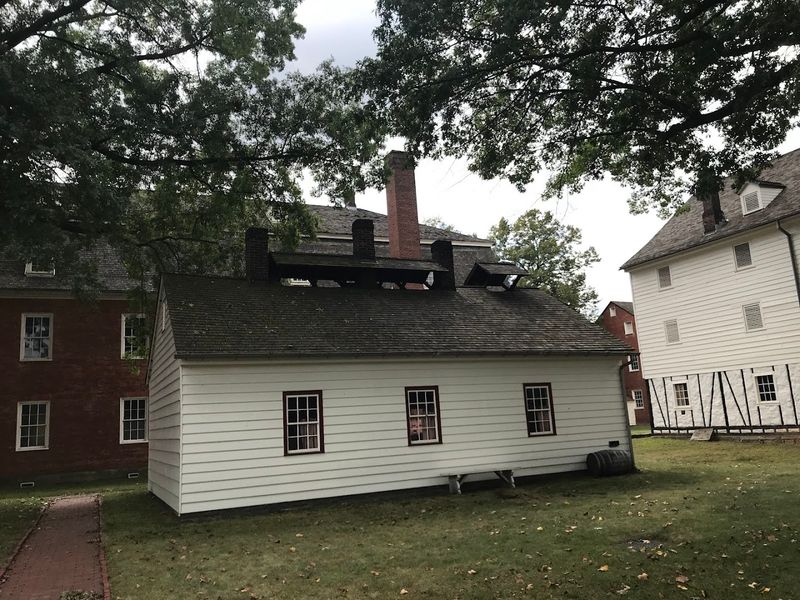
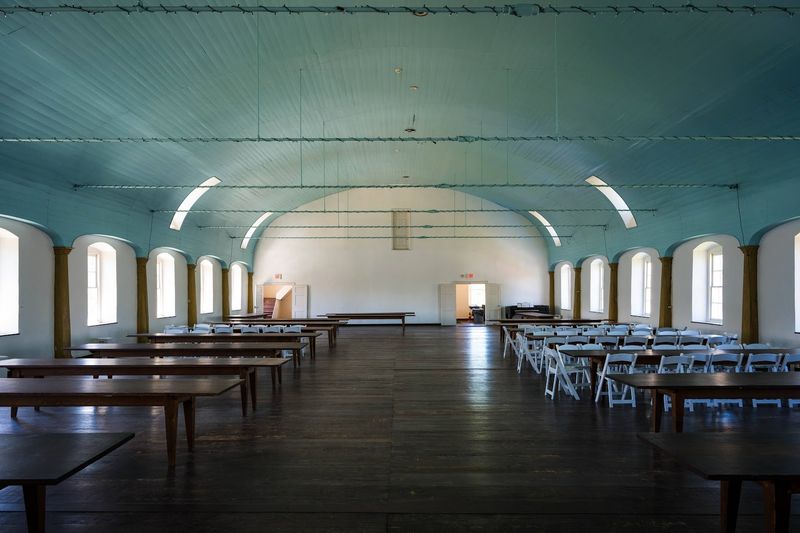
The pleasure of Old Economy Village is that each building has a distinct job, and many still feel marked by that purpose. The connected George Rapp House and Frederick Rapp House anchor the site with an air of authority, while the Feast Hall hints at a community large enough to gather, dine, and perform music together under one roof.
Built in 1827, it could seat about 300 people and even housed a natural history museum downstairs.
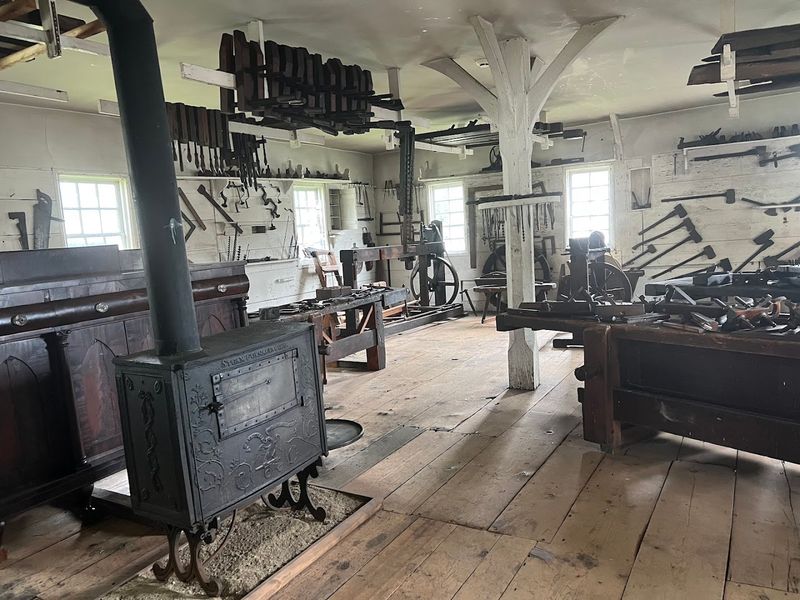
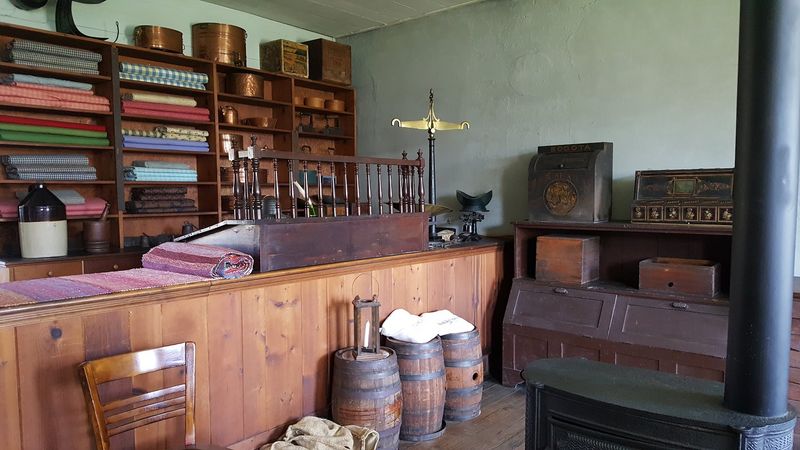
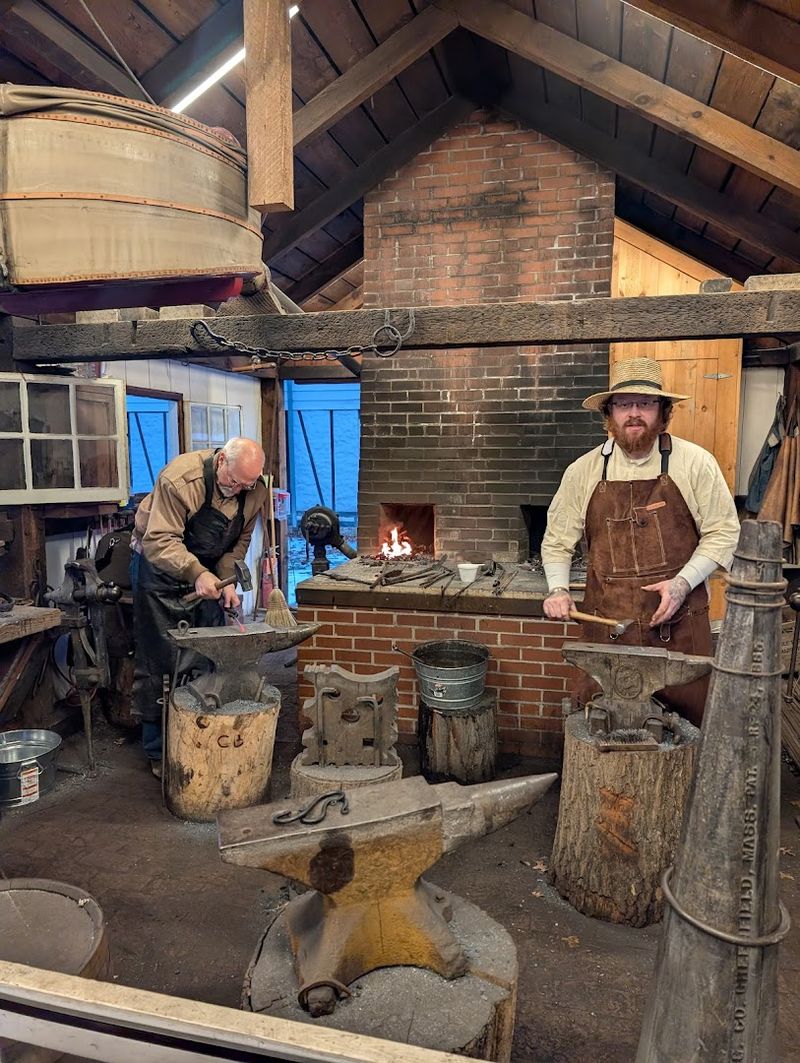
Elsewhere, the surviving granary, store, post office, mechanics building, cabinet shop, wine cellar, and blacksmith shop widen the picture from belief to labor. You are not just visiting homes, but an entire economic organism.
Many structures still hold original furniture, tools, and household objects, which matters because these are not stage props but the material remains of daily use.
That authenticity sharpens every detail. A chair, a workbench, or a doorway becomes evidence of how carefully the Society organized space, production, and communal life around a shared religious mission.
Why the Harmony Society Faded
The decline of the Harmony Society was not dramatic in the way people often expect from utopian experiments. There was no single catastrophe that shattered Economy overnight.
Instead, the community slowly narrowed under the pressure of its own structure, especially celibacy, which meant no new generation was born to inherit the labor, customs, or beliefs of the old one.
New converts became harder to attract as the 19th century moved on, and internal conflicts weakened the Society further, including the major schism of 1832. At its height, the group was astonishingly wealthy, with interests in banking, railroads, oil, and manufacturing, but financial power could not solve the demographic problem.
By 1892, the Society was also significantly in debt, which complicates the image of endless communal prosperity.
I think that is what makes their ending so haunting. They did not collapse in scandal or violence – they simply aged, thinned, and ran out of people, which may be the quietest and saddest failure a utopia can have.
How It Became a State Historic Site
After the last Harmonists died and the Society formally dissolved in 1905 or 1906, the question became what would happen to the village they had left behind. Many places like this vanish through piecemeal sale, neglect, or demolition, but Old Economy took a different path.
Preservation efforts came early enough to save a meaningful section of the original settlement before its character was lost.
The Commonwealth of Pennsylvania eventually acquired about six acres that included 17 original buildings, and the property became the state historic site visitors see today. It is now administered by the Pennsylvania Historical and Museum Commission, with ongoing work to conserve structures, landscapes, and collections.
The wider village was recognized as a National Historic Landmark District in the mid-1960s, affirming its national significance.
That institutional care matters more than it sounds. Because the site was preserved relatively carefully and relatively early, you are able to encounter an actual place rather than a heavily reconstructed memory of one.
Planning a Visit Today
Visiting Old Economy Village today feels manageable, intimate, and much more personal than a giant open-air museum. Most visits begin at the Visitor Center at 270 16th Street in Ambridge, where exhibits and a short orientation video give the story enough context to make the buildings ahead feel legible.
From there, tours often start at the Feast Hall and move through guided and self-guided areas across the historic village.
You should plan on about two hours if you want enough time to absorb the garden, interiors, and museum displays without rushing. The site is generally open Friday through Sunday from April to December, with hours that currently begin at 10 AM on Friday and Saturday and noon on Sunday.
Guided experiences are often praised for feeling conversational rather than scripted, which matches the site’s human scale.
That tone really helps. Instead of being marched through facts, you are invited into the lives behind them, and that makes the whole village feel less distant and more inhabited.
What the Village Leaves You Thinking About
Old Economy Village lingers because it offers something rarer than information: proximity. Standing in rooms furnished with original objects, looking at tools, handwriting, and domestic spaces used by actual Harmonist members, you are forced to drop the abstract version of history and face the ordinary reality of people who once believed they could build a better society by discipline, faith, and shared labor.
Their world becomes difficult to dismiss as quaint.
What moves me most is that the Harmony Society did not end in the sensational way popular memory often prefers. It did not implode through violence, scandal, or theatrical collapse.
It simply ran out of people, because celibacy and dwindling converts made continuation impossible, leaving behind buildings that outlasted the social system that created them.
That kind of ending stays with you on the drive home. Old Economy Village asks whether a dream can still matter even if it cannot reproduce itself, and whether quiet failure may reveal more than dramatic ruin ever could.