
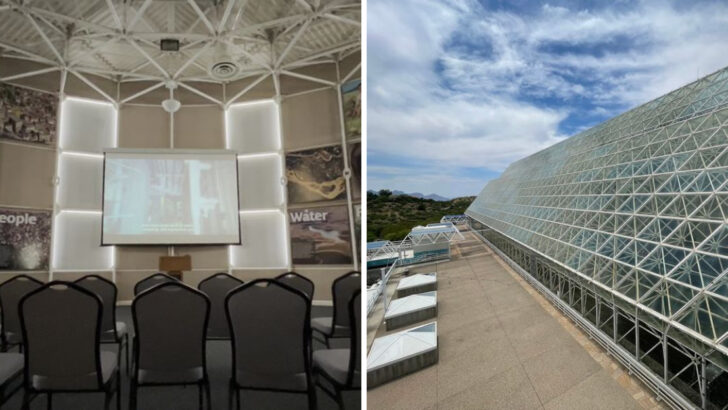
Tucked away in the Sonoran Desert near Oracle, Arizona, sits one of the most extraordinary buildings ever constructed — a massive glass-and-steel structure that holds a rainforest, an ocean, and a desert all under one roof.
Called Biosphere 2, this 3.14-acre facility was built in the late 1980s with a bold mission: to find out if humans could survive in a completely sealed, self-sustaining environment, just like they might need to on the Moon or Mars.
Scientists, engineers, and adventurous researchers have all played a role in making this place one of the most unique scientific experiments on Earth.
Whether you love nature, space, or simply wild ideas that push the limits of human creativity, Biosphere 2 has something that will blow your mind.
What Is Biosphere 2?
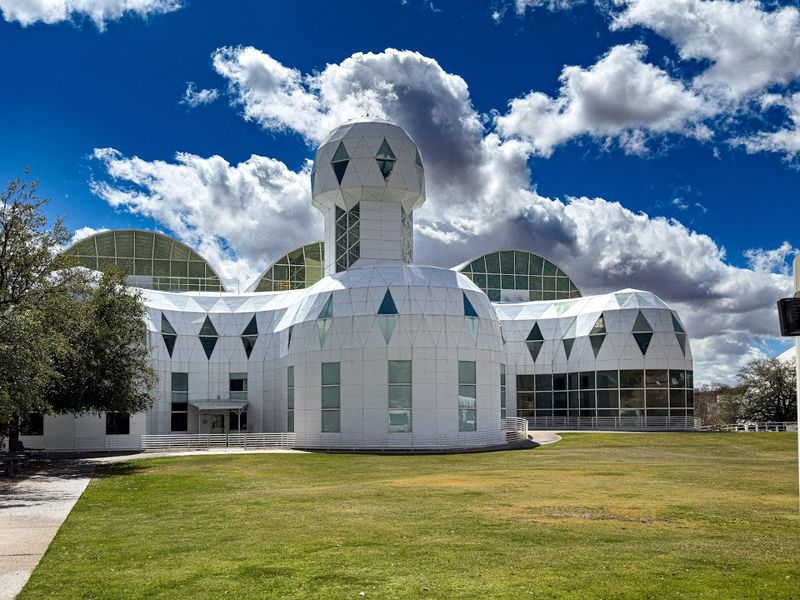
Imagine a city-sized greenhouse sitting in the middle of the Arizona desert, humming with life from rainforests, oceans, and grasslands — all sealed behind glass. That is exactly what Biosphere 2 is.
Located at 32540 S Biosphere Rd, Oracle, AZ 85623, this 3.14-acre glass-and-steel structure is one of the largest closed ecological systems ever built by humans.
The name “Biosphere 2” comes from the idea that Earth itself is “Biosphere 1” — the original life-support system for all living things. Biosphere 2 was designed to be a prototype version, a mini-Earth that scientists could study and control.
It houses multiple distinct ecosystems, from tropical rainforests to saltwater oceans, all existing within the same sealed building.
Visitors today can tour the facility and walk through these incredible environments. Researchers use it to study how ecosystems respond to climate change, water cycles, and human impact.
For anyone curious about science, ecology, or the future of life in space, Biosphere 2 is a one-of-a-kind destination that makes big scientific questions feel surprisingly real and close to home.
Origins and Purpose: Why Was It Built?
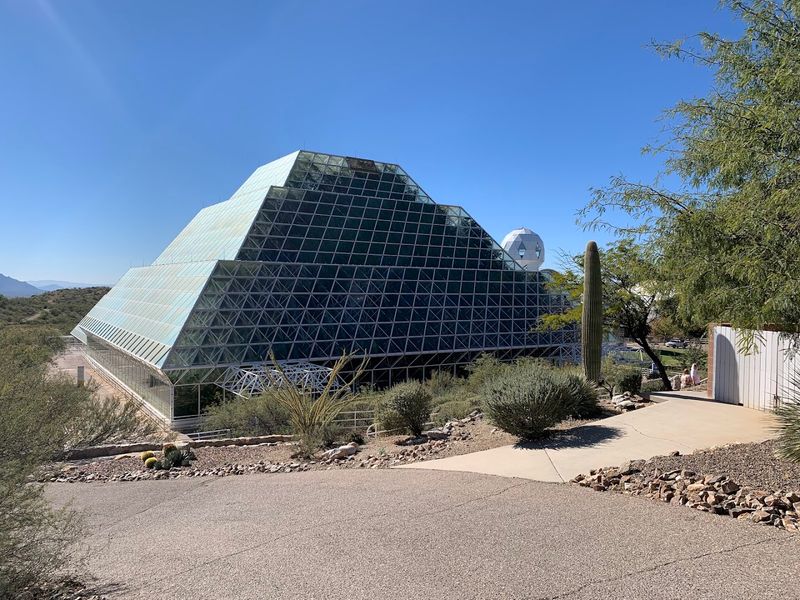
Back in 1987, a company called Space Biosphere Ventures had a bold and almost science-fiction-worthy idea: build a sealed world from scratch and see if humans could live inside it indefinitely. Construction wrapped up in 1991, and the project officially became known as Biosphere 2.
The driving question was simple but profound — could people survive in a completely closed ecological system, growing their own food and recycling their own air and water?
The deeper purpose was space colonization. Scientists understood that if humans ever wanted to live on Mars or the Moon, they would need to create self-sustaining habitats.
Biosphere 2 was meant to serve as a testing ground for exactly that kind of challenge. Every crop grown, every breath recycled, and every drop of water purified inside the structure gave researchers valuable data about what works — and what does not.
Fun fact: the project cost around $200 million to build, making it one of the most expensive scientific experiments of its era. That investment reflected just how seriously its creators took the goal of preparing humanity for a future beyond Earth.
The ambition behind Biosphere 2 remains as inspiring today as it was decades ago.
Engineering the Iconic Glass Structure
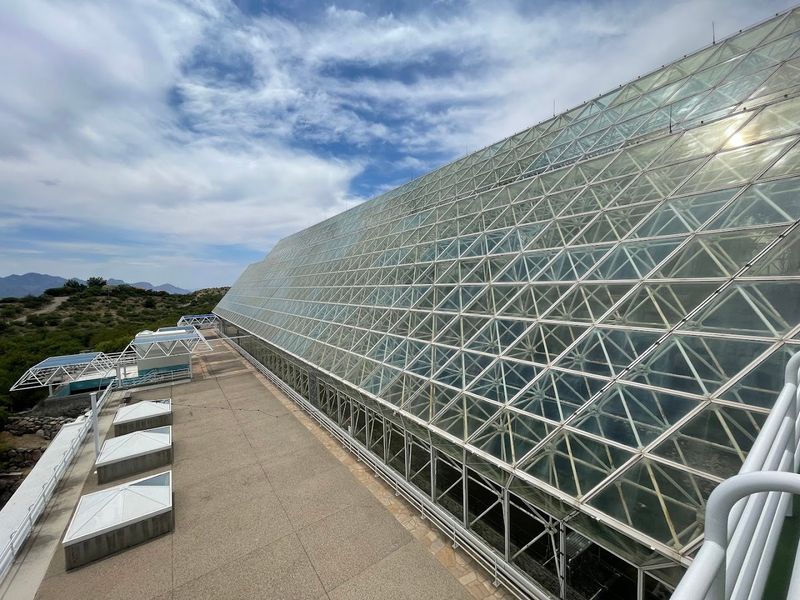
Few buildings in the world look quite like Biosphere 2. Its angular glass panels and white steel frames give it the appearance of a giant crystal spaceship that landed in the desert.
But behind that striking design is some seriously impressive engineering. The entire structure spans over three acres and is sealed as airtight as possible, preventing outside air from mixing with the carefully controlled atmosphere inside.
The glass panels were specially selected to allow maximum sunlight to reach the plants and ecosystems within, since photosynthesis powers much of the biosphere’s life. Steel space frames hold everything together while being strong enough to withstand Arizona’s extreme heat and occasional high winds.
Engineers also had to account for air pressure changes caused by temperature swings, which led to the creation of two large “lung” chambers that expand and contract to equalize pressure inside the dome.
Those lung chambers are one of the most clever engineering solutions in the whole facility. Without them, the glass panels could crack under pressure differences between day and night temperatures.
The thoughtfulness behind every structural detail shows just how much planning went into turning a wild scientific dream into a real, functioning building that has now stood for over three decades.
The Tropical Rainforest Biome Inside
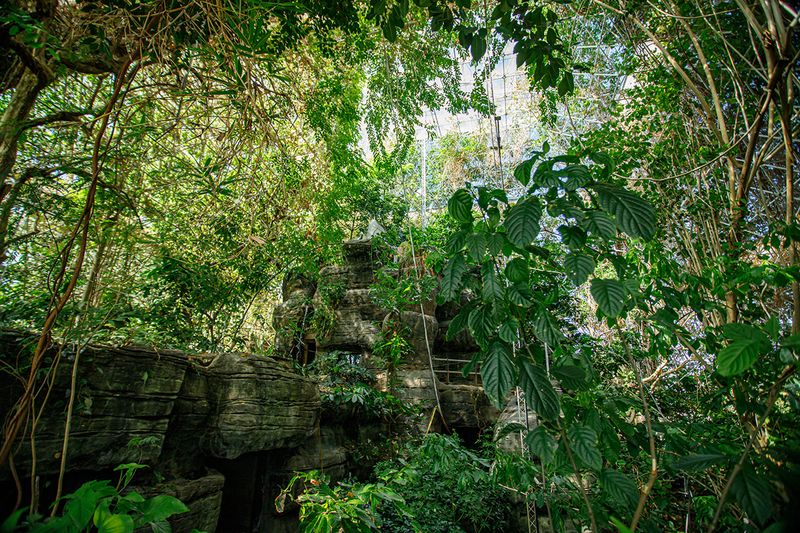
Step through the right door inside Biosphere 2 and suddenly you are surrounded by a dripping, green, towering tropical rainforest — in the middle of the Arizona desert. This biome is one of the largest sections of the facility and one of the most visually stunning.
Tall trees stretch toward the glass ceiling, vines twist between branches, and layers of plants fill every inch of space from the forest floor to the canopy above.
Scientists designed this biome to mimic the humid, densely vegetated ecosystems found in places like the Amazon. One of the key research goals here is understanding carbon dynamics — how plants absorb carbon dioxide and release oxygen.
This has become even more relevant today as climate change puts real-world rainforests under increasing pressure.
Researchers have learned a great deal from watching how this miniature rainforest responds to changes in light, temperature, and atmospheric chemistry. Some species thrived unexpectedly, while others struggled in ways scientists did not predict.
Those surprises turned out to be some of the most valuable lessons of all, reminding ecologists that nature is far more complex and unpredictable than any model can fully capture. The rainforest biome remains one of Biosphere 2’s most actively studied environments today.
The Man-Made Ocean with a Coral Reef
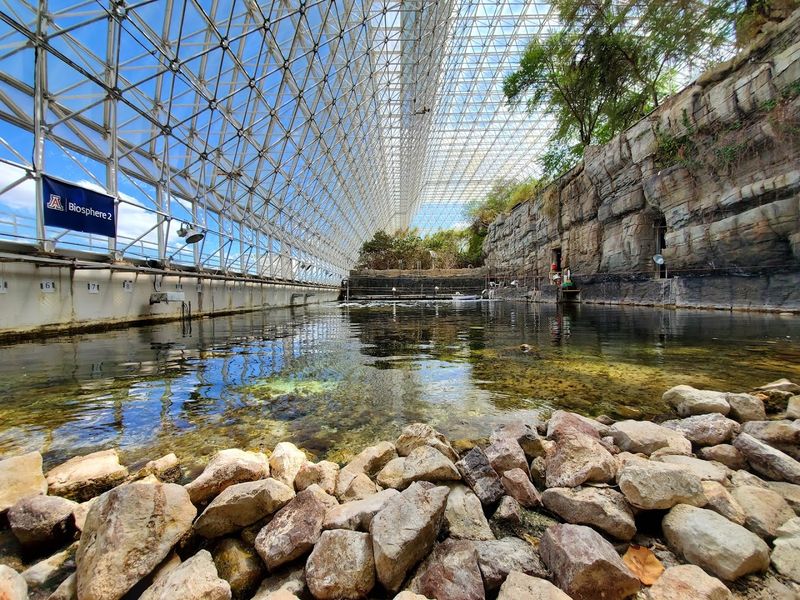
Not many places on Earth let you stand in a desert and look down at a coral reef, but Biosphere 2 pulls it off. The facility includes a man-made saltwater ocean biome complete with a living coral reef, wave-generating machines, and a carefully maintained marine environment.
It holds about 700,000 gallons of saltwater and was built to replicate the chemistry and movement of a real ocean as closely as possible.
Researchers use this biome to study marine ecology in ways that would be nearly impossible in the open ocean. They can control variables like water temperature, salinity, and carbon dioxide levels, then observe exactly how the coral reef responds.
This kind of controlled research has become critically important as scientists work to understand ocean acidification — a real-world threat caused by rising carbon dioxide levels that is bleaching and killing coral reefs around the globe.
The wave machines inside the biome are a particularly fascinating touch. They keep the water moving and oxygenated, just like the tides and currents of a natural ocean.
Watching waves roll across an indoor coral reef while standing in the Arizona desert is one of those experiences that makes Biosphere 2 feel like a genuinely magical place, even for the most science-minded visitors.
The Fog Desert and Other Land Biomes
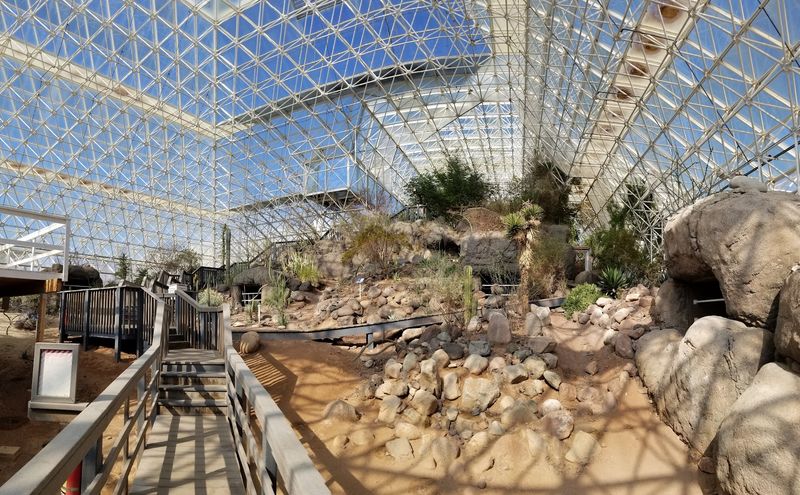
While the rainforest and ocean get a lot of attention, Biosphere 2 also contains a fog desert biome that is quietly fascinating in its own right. Unlike the hot, sun-scorched desert just outside the building’s walls, this biome simulates the cool, moisture-rich conditions of coastal fog deserts found in places like Baja California and the Canary Islands.
Succulents, shrubs, and drought-adapted plants thrive here in conditions that most people would never associate with the word “desert.”
Beyond the fog desert, Biosphere 2 also includes savanna grassland and mangrove wetland biomes. Each of these environments represents a completely different climate system, and having them all under one roof allows scientists to compare how they function side by side.
The savanna section features grasses and scattered trees that mirror African and South American grasslands, while the mangrove wetlands recreate the tangled, waterlogged ecosystems found along tropical coastlines.
Having five distinct land biomes in a single building is an extraordinary scientific achievement. Researchers can study how each ecosystem handles stress, drought, or changes in carbon levels without the complications of working in the unpredictable real world.
For students and visitors, walking between such different environments in just a few minutes makes ecology feel exciting and surprisingly easy to understand.
Human Habitat and Agricultural Zones
Living inside a sealed glass structure for months at a time sounds like something from a science fiction novel, but for the crew members of Biosphere 2, it was very real daily life. The facility includes dedicated human living quarters — small but functional apartments where crew members slept, cooked, and spent their downtime.
Right alongside those living spaces were agricultural areas designed to produce enough food to feed everyone inside without any supplies coming from outside.
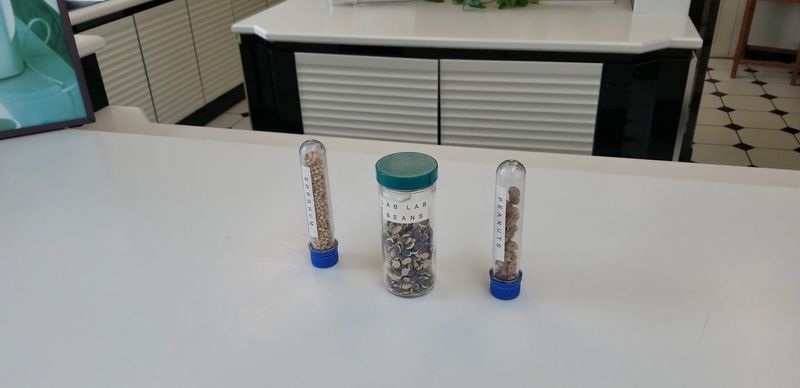
Crew members grew crops like sweet potatoes, rice, beans, wheat, and vegetables in carefully managed plots. They also raised small animals, including goats and chickens, to supplement their diet with protein.
Every meal had to come from what they could grow themselves, which made farming one of the most critical daily tasks inside the biosphere.
This agricultural challenge is directly relevant to future space missions. Astronauts traveling to Mars would face a similar situation — no grocery stores, no supply runs, just whatever food they can grow on board.
The lessons learned inside Biosphere 2 about crop yields, soil health, and caloric planning have directly informed NASA research on bioregenerative life support systems. Growing food in space is hard, but the experiments at Biosphere 2 gave scientists a real head start on figuring it out.
The Closed-Mission Experiments of the 1990s
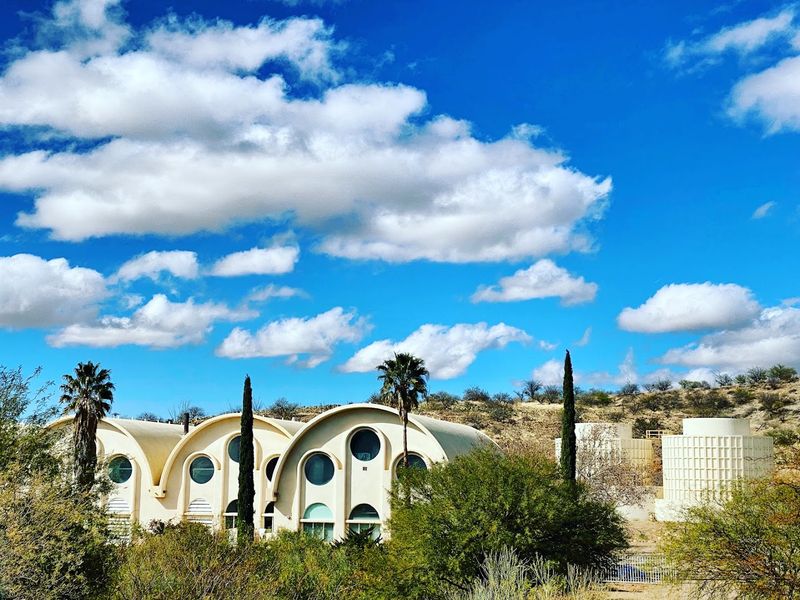
In September 1991, eight people walked into Biosphere 2, the door sealed behind them, and they did not come out for two full years. These brave volunteers, called “Biospherians,” were tasked with farming their own food, managing the ecosystems, and living as self-sufficiently as possible inside the sealed structure.
It was one of the most ambitious human experiments ever attempted, and it did not go exactly as planned.
Oxygen levels inside the biosphere unexpectedly dropped over time, eventually falling low enough to affect crew members physically and mentally. Scientists later discovered that microbes in the soil were consuming oxygen faster than the plants could replace it.
Food production also fell short of what was needed, leaving crew members significantly underfed throughout much of their stay. Despite these hardships, the team persevered and completed their two-year mission.
A second mission in 1994 ended early due to management conflicts, adding a dramatic chapter to Biosphere 2’s already complicated story. But even the failures taught scientists enormously valuable lessons about the fragility of closed ecosystems and the unexpected ways that biological systems can behave.
Those hard-earned insights are now considered some of the most important data ever collected about what it truly takes to sustain human life in an isolated, sealed environment.
Transition to Modern Scientific Research
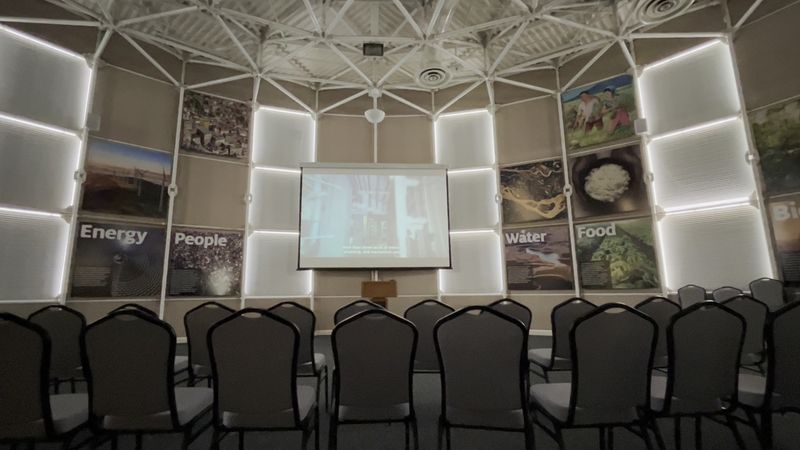
After the dramatic closed missions of the 1990s, Biosphere 2 went through some turbulent years of management changes and uncertainty about its future. Columbia University took over operations for a while, then in 2011 the University of Arizona stepped in and transformed the facility into something remarkable — a world-class research center focused on climate science, ecology, hydrology, and sustainability.
Today, researchers at Biosphere 2 run cutting-edge experiments that have nothing to do with sealed human missions. One of the most exciting ongoing projects is the Landscape Evolution Observatory, or LEO, which fills three giant hillslopes with crushed basalt rock to study how water, plants, and microbes transform bare rock into soil over time.
This kind of research helps scientists understand how land and water interact on a fundamental level.
Climate change research is another major focus. Scientists use the controlled environments inside Biosphere 2 to test how ecosystems respond to rising temperatures, drought, and shifting precipitation patterns — all urgent questions as the real world faces accelerating climate disruption.
The University of Arizona has essentially turned a once-controversial experiment into one of the most productive ecological research facilities on the planet, attracting scientists from around the world to work within its glass walls.
Legacy and Its Relevance to Space Exploration
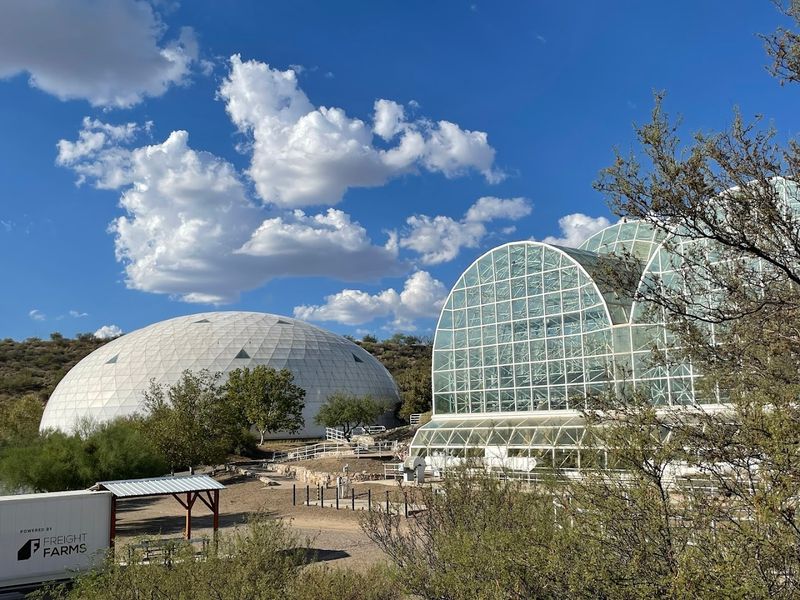
Even though the original closed-system missions ran into serious problems, Biosphere 2 left a legacy that researchers and space agencies continue to build on today. The project proved that you can engineer complex, functioning ecosystems inside a sealed structure — a concept that is absolutely essential for any long-term human presence on the Moon or Mars.
The engineering challenges it exposed, from oxygen management to food production, have shaped how scientists think about designing future space habitats.
NASA and other space agencies have studied Biosphere 2’s results carefully. The lessons about bioregenerative life support — using plants and microbes to recycle air, water, and nutrients — are central to plans for future lunar bases and Mars colonies.
Getting those biological systems right could mean the difference between a successful mission and a catastrophic one.
Beyond space, Biosphere 2 reminds us how fragile and interconnected life on Earth really is. Watching a miniature world struggle to stay balanced inside a glass building puts into sharp perspective just how remarkable and delicate our own planet’s ecosystems are.
The structure in Oracle, Arizona is more than a scientific curiosity — it is a monument to human ambition, a laboratory for the future, and a powerful reminder of why protecting Earth’s original biosphere matters so deeply.