
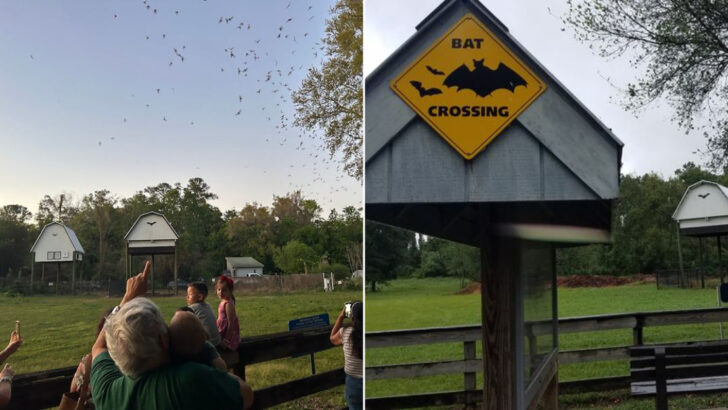
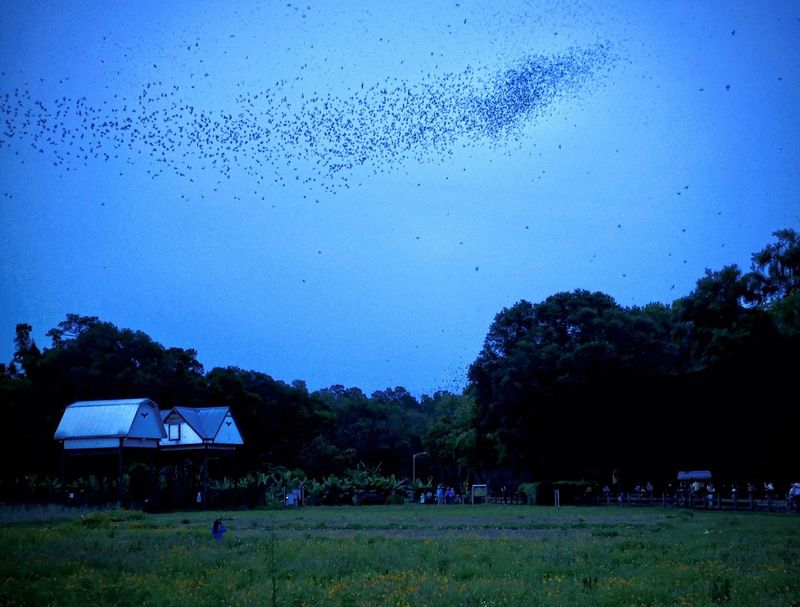
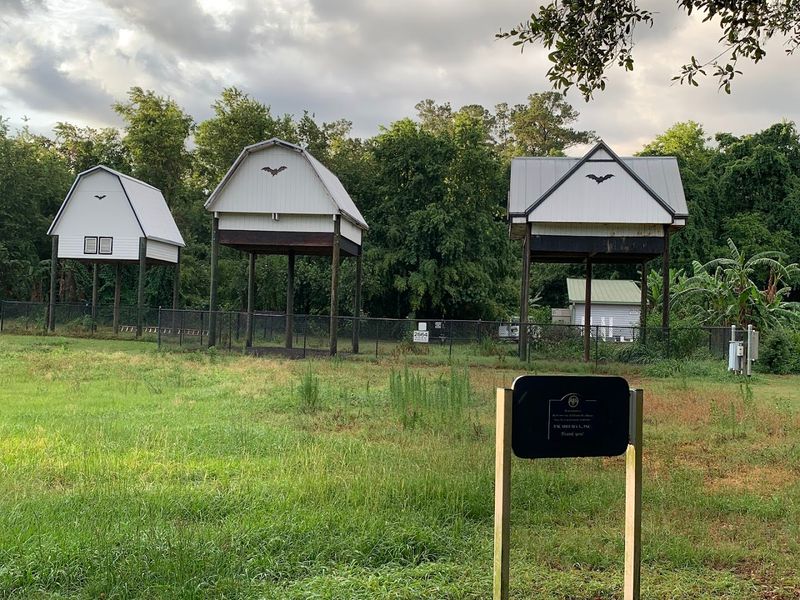
Tucked away on the campus of the University of Florida in Gainesville, the UF Bat Houses are home to one of the most jaw-dropping wildlife spectacles you can witness for free in the United States. Every evening around sunset, nearly half a million bats pour out of two wooden structures in a swirling, river-like stream that darkens the sky.
These bat houses are officially recognized as the largest occupied bat houses in the world, drawing visitors, scientists, and curious families year-round. Whether you are a nature lover, a student, or just someone looking for something unforgettable to do, the UF Bat Houses will leave you speechless.
The History Behind the UF Bat Houses
Back in the 1980s, the University of Florida had a problem — thousands of free-tailed bats were living inside Ben Hill Griffin Stadium, the famous Gator football stadium. University officials needed to relocate the bats without harming them, so they came up with a creative and compassionate solution.
In 1991, the first bat house was built on Museum Road near Lake Alice. At first, the bats were slow to move in.
The structure sat mostly empty for several years, which frustrated wildlife managers and bat enthusiasts alike. A second, larger bat house was built right next to it in 2010, and that is when the colony truly exploded in size.
Today, the two structures together house an estimated 300,000 to 500,000 Brazilian free-tailed bats and Southeastern bats. The story of the UF Bat Houses is really a conservation success story — proof that humans and wildlife can coexist with a little creativity.
The project has since become a model for bat relocation efforts across the country, showing universities and cities that protecting wildlife does not have to come at the expense of human spaces.
What Makes These Bat Houses the Largest in the World
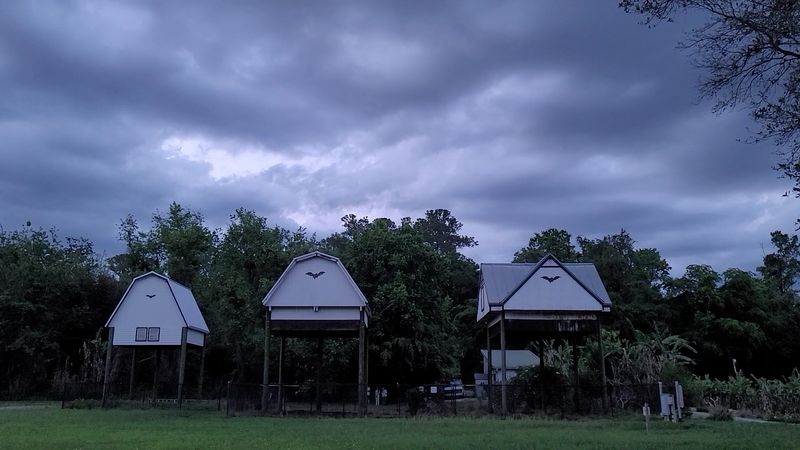
Size matters when it comes to bat houses, and the UF Bat Houses hold the title of the world’s largest occupied bat houses — and it is not even close. The primary bat house stands about 35 feet tall, and together the two structures provide enough roosting space for hundreds of thousands of bats at once.
No other human-built bat house on the planet comes close to hosting this many animals.
The structures are made of wood and are carefully engineered to maintain the warm interior temperatures that Brazilian free-tailed bats need to thrive. The inside temperature can reach over 100 degrees Fahrenheit on hot Florida days, which is exactly what the bats prefer for raising their young.
Ventilation slots and dark interior chambers are designed with bat biology in mind.
Maintaining world-record status requires constant upkeep. University staff and bat researchers regularly monitor the colony’s health and the structural integrity of the houses.
Visitors standing near the buildings during the day can actually hear the rustling and chirping of hundreds of thousands of bats packed inside — a sound that is equal parts eerie and fascinating. It is a true engineering marvel built entirely for wildlife.
The Incredible Evening Emergence Spectacle
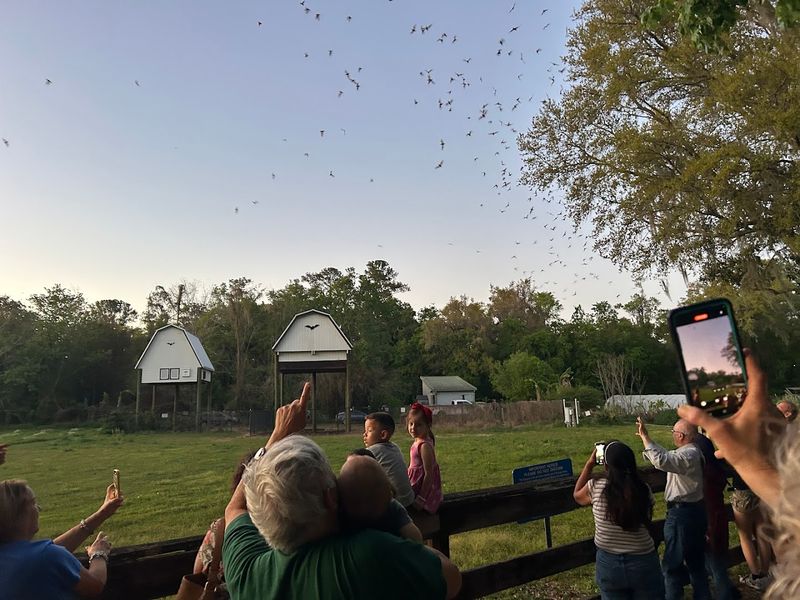
Picture this: the sun dips below the horizon, the sky turns shades of orange and pink, and then — like a switch was flipped — a dark, swirling river of bats begins pouring out of two wooden structures. That is the evening emergence at the UF Bat Houses, and it is something people genuinely travel from across the country to witness.
The bats typically begin emerging about 10 to 15 minutes after sunset. The Southeastern bats usually come out first, just a handful at a time.
Then, all at once, the massive swarm of Brazilian free-tailed bats erupts from the houses in a continuous stream that can last several breathtaking minutes. Visitors often describe it as watching a living river flow through the sky.
On a good warm evening, up to half a million bats can emerge in this single event. The sound, the smell, and the sheer visual scale of the moment create an experience that is hard to put into words.
Reviewers on Google consistently give it five stars, with many calling it one of the most magical natural events they have ever seen. Bring a blanket, arrive early, and face the houses — not the lake — for the best view.
Meet the Residents: Brazilian Free-Tailed Bats
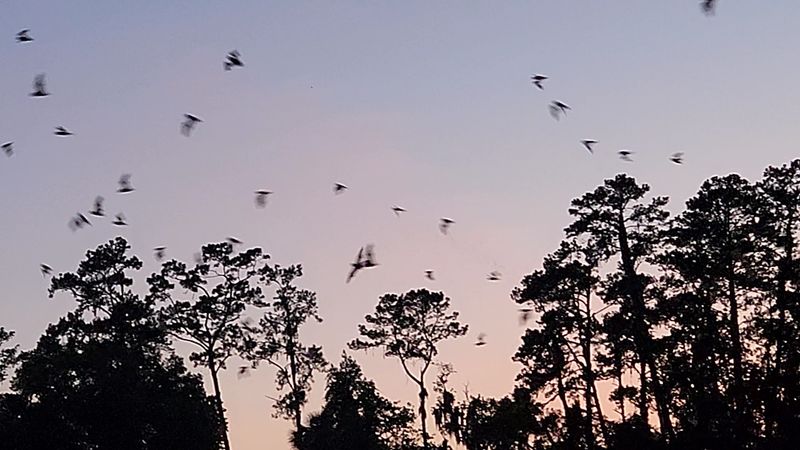
The star residents of the UF Bat Houses are the Brazilian free-tailed bats, scientifically known as Tadarida brasiliensis. These are some of the fastest flying mammals on Earth, capable of reaching speeds over 99 miles per hour in level flight.
Watching half a million of them pour into the night sky is like watching nature show off.
Brazilian free-tailed bats are migratory, spending winters in Mexico and Central America and returning to Florida each spring to breed. The females give birth to a single pup each year, and the bat houses serve as a massive maternity colony where mothers raise their young.
By late summer, the colony swells as pups grow old enough to join the nightly flights.
These bats are insectivores, meaning they eat only insects. Each night, the colony at UF collectively consumes an estimated 2.5 billion insects — that is roughly 2,500 pounds of bugs every single night.
Mosquitoes, moths, and agricultural pests are all on the menu. Farmers across the region benefit enormously from having such a massive colony nearby.
These little mammals are unsung heroes of the ecosystem, doing pest control work that would otherwise cost millions of dollars.
How the Bat Houses Benefit the Environment
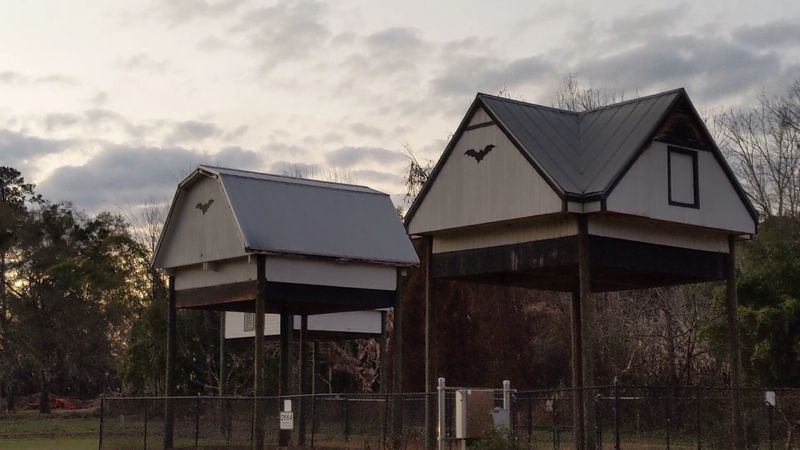
Half a million bats eating 2,500 pounds of insects every single night is not just an impressive statistic — it is an enormous environmental benefit. The UF Bat Houses essentially operate as a round-the-clock, natural pest control service for the entire Gainesville region.
Farmers, gardeners, and homeowners all benefit from having this massive colony nearby, even if they never visit the bat houses themselves.
Beyond pest control, bats play a critical role in pollination and seed dispersal in tropical and subtropical ecosystems. While the species at UF are primarily insectivores, the broader conservation value of protecting and studying a colony this size cannot be overstated.
Researchers from the University of Florida use the colony to study bat migration, disease resistance, echolocation, and population dynamics.
The bat houses also serve as a living classroom for students in biology, ecology, and wildlife management. Data collected at the UF colony has contributed to scientific papers and conservation strategies used far beyond Florida’s borders.
By protecting and maintaining these structures, the University of Florida is actively contributing to the health of local ecosystems and supporting the kind of biodiversity that keeps natural systems in balance. It is conservation happening right in a college neighborhood.
Visiting Tips: When and How to See the Bats
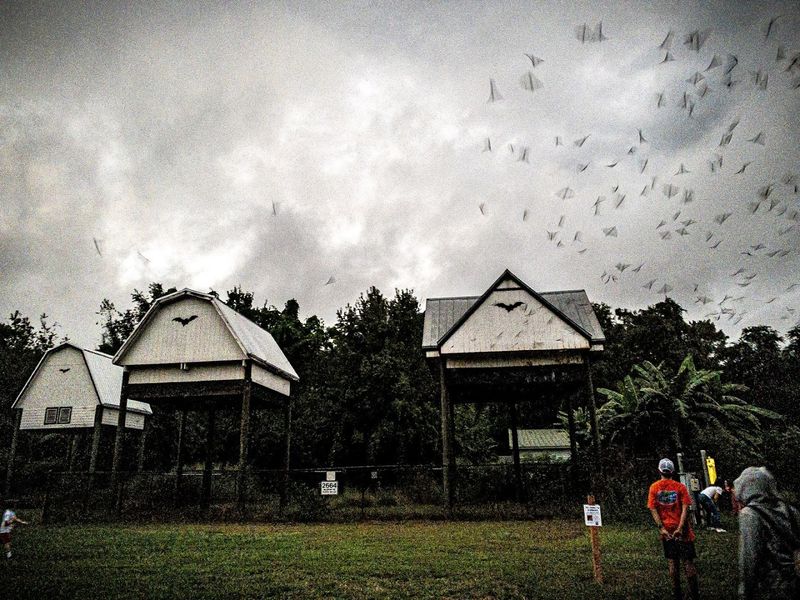
Timing is everything when visiting the UF Bat Houses. The bats emerge roughly 10 to 15 minutes after sunset, so arriving about 30 minutes early is a smart move, especially on warm evenings when crowds can be large.
The bat houses are open for viewing from 6 PM to 9 PM every day of the week, making them accessible for both weeknight and weekend visits.
Face the bat houses directly — not the lake — to catch the full emergence. Many first-time visitors make the mistake of standing with their backs to the structures, admiring Lake Alice, and then missing the initial burst of bats.
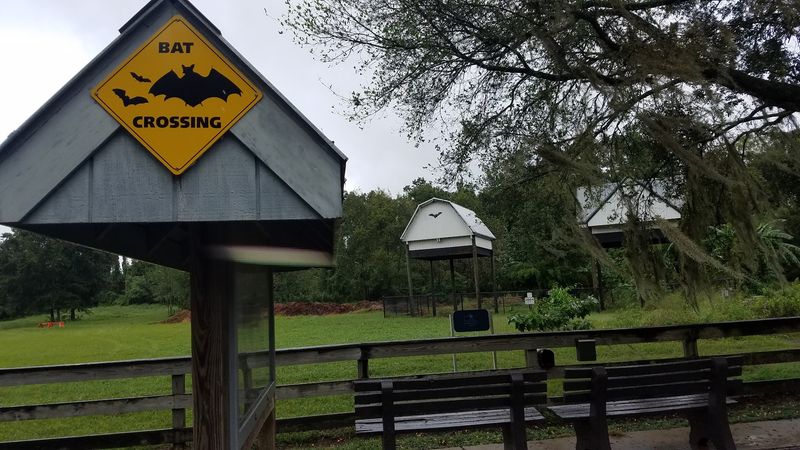
The sidewalk area in front of the houses has benches and open grassy space where visitors can sit comfortably. Bringing a folding chair or a blanket is a great idea, especially for families with kids.
Warm evenings between spring and early fall offer the best chances for a full emergence. On cold nights below 60 degrees Fahrenheit, the bats tend to stay inside.
Free parking is available nearby, and restrooms are accessible in the area. The address is Museum Road, Gainesville, FL 32611, right next to the beautiful Lake Alice.
Plan to stay for at least an hour to soak in the full experience.
Lake Alice: The Perfect Backdrop for a Bat-Watching Evening
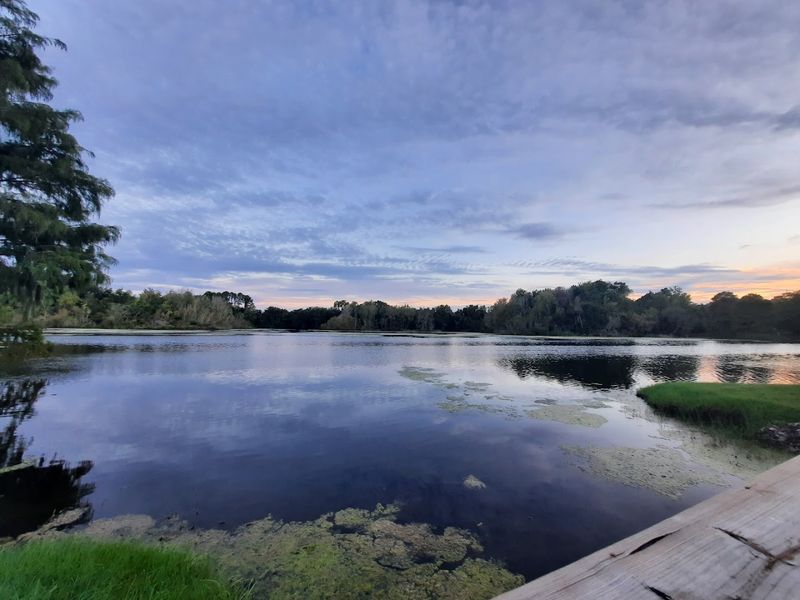
Directly across the road from the UF Bat Houses sits Lake Alice, one of the most serene and wildlife-rich spots on the entire University of Florida campus. Covered in Spanish moss-draped trees and surrounded by native Florida vegetation, the lake provides a stunning natural backdrop that makes the bat-watching experience feel even more magical.
Lake Alice is also home to a resident population of American alligators, which adds a surprising thrill to an already exciting evening. Visitors often spot gators lounging near the water’s edge while waiting for the bats to emerge.
Wading birds, turtles, and occasional otters also make appearances, turning the whole visit into a full-on wildlife encounter rather than just a bat event.
The peaceful atmosphere around Lake Alice is part of what makes the UF Bat Houses experience so special. People gather quietly in the fading light, sharing snacks, chatting softly, and enjoying the cool Florida breeze off the water.
It feels like a community event where strangers become fellow nature enthusiasts for one evening. More than a few reviewers have described the combination of Lake Alice and the bat emergence as genuinely one of the most relaxing and awe-inspiring evenings they have ever spent outdoors.
The Role of UF Researchers in Bat Conservation
The UF Bat Houses are not just a tourist attraction — they are an active research site. Scientists and graduate students from the University of Florida’s Florida Museum of Natural History and Department of Wildlife Ecology regularly study the colony to gather data on bat health, behavior, and population trends.
The sheer size of the colony makes it an invaluable resource for bat research.
One major focus of research at the site involves White-Nose Syndrome, a devastating fungal disease that has killed millions of bats across North America. By monitoring the UF colony closely, researchers can track whether the disease is spreading into Florida’s bat populations and develop strategies to protect them.
The colony also provides data on how urban bat populations respond to climate change and habitat loss.
Students conducting fieldwork at the bat houses gain hands-on experience that textbooks simply cannot replicate. Counting bats, analyzing echolocation recordings, and studying roosting behavior are all part of the scientific work happening right on Museum Road.
The Florida Museum of Natural History’s website at floridamuseum.ufl.edu/bats offers resources and updates about ongoing research. The UF Bat Houses stand as a living laboratory where conservation science and public education happen side by side every single evening.
Fun Facts That Will Make You Love Bats Even More
Ready for some numbers that will blow your mind? The bats at the UF Bat Houses collectively eat an estimated 2.5 billion insects every single night.
That works out to roughly 2,500 pounds of bugs consumed between sunset and sunrise. If those insects were left unchecked, the agricultural and public health costs would be staggering.
Brazilian free-tailed bats are also record-breakers in the animal kingdom. Studies have clocked them flying at over 99 miles per hour in level flight, making them the fastest horizontal fliers of any animal on Earth.
They use echolocation — a biological sonar system — to detect and catch insects in complete darkness with pinpoint accuracy. Each bat can catch hundreds of insects per hour during a single nightly foraging trip.
Another surprising fact: female bats in the colony can identify their own pup among hundreds of thousands of other pups using a unique combination of sound and smell. Bat pups grow incredibly fast and are ready to fly within about five weeks of birth.
The UF colony rates a perfect 4.8 stars on Google with over 1,000 reviews, making it one of the highest-rated free attractions in all of Gainesville. Nature, it turns out, puts on the best show.