
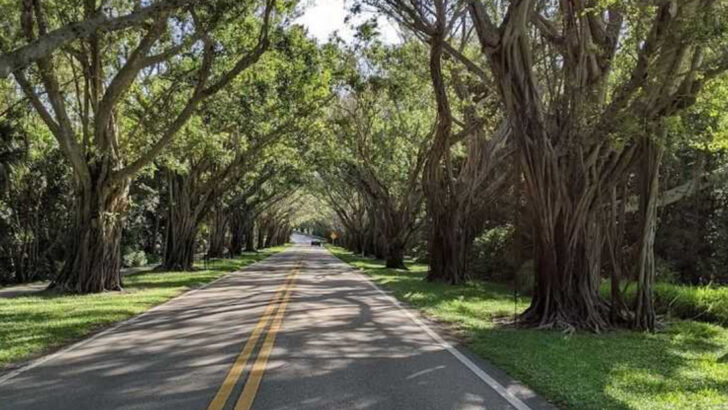
Tucked away in the coastal town of Hobe Sound, Florida, a stretch of road called the Tunnel of Trees feels like something straight out of a storybook.
Massive banyan trees line both sides of Bridge Road, their branches curling overhead to form a stunning natural canopy that stretches for what feels like forever.
Most drivers stumble upon it by chance and end up stopping just to soak in the magic.
Whether you love nature, photography, or simply a scenic road trip, this hidden gem deserves a spot on your Florida bucket list.
The Road That Feels Like Entering a Living Tunnel

Picture yourself driving down a regular Florida road when suddenly, the sky disappears. That is exactly what happens when you turn onto Bridge Road near Hobe Sound and enter the famous Tunnel of Trees.
Towering banyan trees rise on both sides of the road, their enormous branches stretching outward and arching high overhead to create a natural canopy unlike anything most people have ever seen.
The effect is immediate and almost surreal. Sunlight filters through the dense foliage in shifting patterns, casting a soft green glow across the pavement.
Many first-time visitors instinctively press the brakes, not out of caution, but out of sheer wonder. There is a quiet magic to this place that slows everything down.
Even frequent commuters who travel this road regularly admit it never quite loses its charm. On cloudy days, the tunnel feels moody and dramatic.
On sunny afternoons, the dappled light dances across the road like something from a dream. Whether you are a nature lover, a casual traveler, or someone just passing through Martin County, driving through this canopy is one of those rare moments that genuinely stops you in your tracks.
Banyan Trees That Form the Signature Canopy
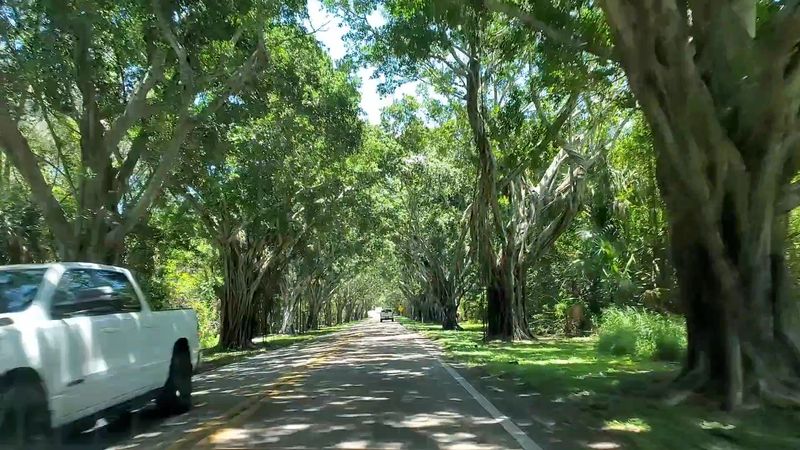
Not just any trees could pull off this kind of spectacle. Banyan trees are famously dramatic, known for their sprawling canopies and the curtain-like aerial roots that drop from their branches toward the ground.
Along Bridge Road, these giants have had decades to grow, and the result is nothing short of architectural.
What makes banyans so visually striking is how they expand. Instead of growing only upward, they send roots downward from their branches, which then anchor into the soil and become new trunks.
Over time, a single banyan can cover an enormous area. Here, that growth pattern has caused the trees on opposite sides of the road to reach toward each other, weaving their branches together into one connected living roof.
Standing beneath these trees, you really feel their age and scale. The trunks are wide and gnarled, and the root systems look like something a sculptor might dream up.
Fun fact: banyan trees are actually a species of fig, making them distant relatives of the fruit you find at the grocery store. That surprising detail adds a quirky layer to an already fascinating roadside experience worth savoring slowly.
A Drive Rooted in Local History

Back in the 1930s, the Hobe Sound Company had a vision. They wanted the road leading to Jupiter Island to feel welcoming and beautiful, so they made a simple but consequential decision: plant banyan trees along Bridge Road.
What started as a landscaping project eventually became one of Martin County’s most beloved natural landmarks, though nobody could have predicted just how spectacular those trees would become.
Nearly a century of growth has transformed that original planting into the breathtaking canopy visitors enjoy today. The trees were never meant to become famous.
They were just meant to provide shade and a pleasant visual for residents and guests heading toward the island. Yet sometimes the most extraordinary things start with the most ordinary intentions.
Understanding this history makes the drive feel even richer. You are not just passing through greenery.
You are traveling beneath living history, beneath branches that have witnessed decades of Florida life. The road has seen countless cars, families, storms, and seasons, yet those trees have kept growing, kept reaching, and kept creating something genuinely worth preserving.
Knowing the backstory adds an emotional layer that transforms a simple drive into something almost sentimental.
A Rare Slice of Old Florida

Spend any time along Florida’s coasts and you quickly notice how much has changed. Strip malls, high-rise condos, and busy tourist corridors have replaced much of what once made Florida feel wild and unhurried.
That is what makes the Tunnel of Trees so emotionally resonant for so many people. It is one of the few places left where you can feel what Florida used to be like before the crowds arrived.
The thick canopy blocks out the noise of modern development, both literally and figuratively. Underneath those branches, there are no billboards, no fast-food signs, and no sense of commercial rush.
Just shade, birdsong, and the quiet hum of tires on pavement. For longtime Florida residents especially, the tunnel stirs a deep nostalgia for a slower, greener era.
Visitors from out of state often remark that the Tunnel of Trees does not match their mental image of Florida at all. They expect beaches and sunshine, not a mysterious leafy corridor straight out of the Deep South.
That surprise is part of the charm. Old Florida still exists in pockets like this one, and Bridge Road is proof that not everything worth treasuring has been paved over or built upon.
A Photographer’s Dream Spot
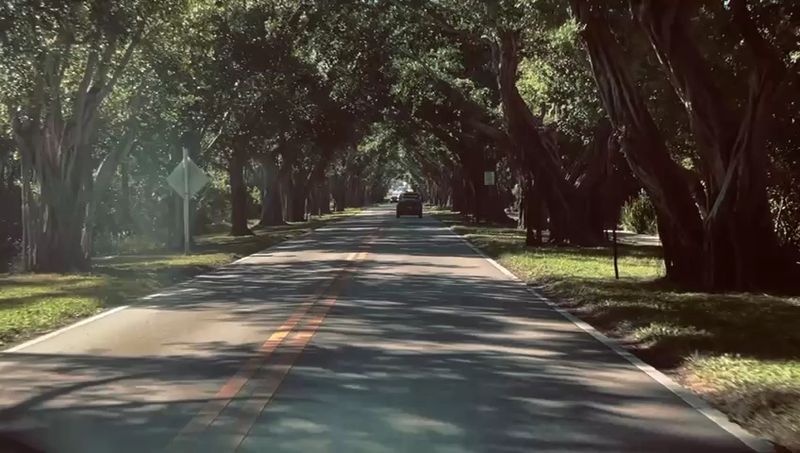
Golden hour at the Tunnel of Trees is something photographers genuinely chase. When the sun sits low in the sky, light filters through the banyan branches at a soft angle, scattering across the road in warm, shifting patterns that are nearly impossible to recreate in a studio.
The combination of organic textures, deep shadows, and glowing patches of light makes every frame look like a painting.
Engagement photographers, portrait artists, and travel bloggers all make the trip to Bridge Road for good reason. The canopy provides natural diffusion for harsh sunlight, acting almost like a giant softbox.
Subjects photographed beneath the archway tend to be lit evenly and beautifully, with the lush green background adding depth and color without overwhelming the composition.
Even smartphone photographers come away with stunning shots here. The scene is simply that cooperative.
Early morning visits reward those willing to wake up early with misty light and empty roads, creating a hauntingly peaceful atmosphere. Late afternoon brings warmer tones and longer shadows.
Honestly, it is hard to take a bad photo in this spot. If you visit with any kind of camera, plan to stay longer than you expected because one shot never feels like enough.
More Than Just a Drive, It Is Walkable Too

Most people experience the Tunnel of Trees from inside a moving car, but slowing down even further reveals something much richer. Sidewalks run alongside Bridge Road, giving pedestrians the chance to walk directly beneath the canopy and experience the trees up close in a way that driving simply cannot offer.
Once you are on foot, the scale of everything becomes genuinely overwhelming in the best possible way.
Walking lets you notice details that blur past at driving speed. The enormous girth of individual trunks.
The way aerial roots cascade from branches like tangled curtains. The texture of bark that has been growing and thickening for nearly a hundred years.
Birdsong fills the shaded corridor, and the air feels noticeably cooler beneath the dense foliage than it does just a few feet away in open sunlight.
Families with strollers, joggers, cyclists, and casual walkers all share this peaceful stretch regularly. It is an accessible outdoor experience that requires no gear, no admission fee, and no special fitness level.
Just comfortable shoes and a willingness to slow down. If you have only ever driven through the Tunnel of Trees, consider parking nearby and taking even a short walk beneath the canopy.
The experience is genuinely different and deeply satisfying.
The Gateway to Jupiter Island and the Coast

Bridge Road does not just offer scenic beauty. It actually serves a practical purpose, connecting U.S.
Route 1 in Hobe Sound to Jupiter Island and the Atlantic coast beyond. That means the Tunnel of Trees is not a dead-end detour.
It is a working road that thousands of beachgoers travel regularly, often without realizing they are passing through one of the most photogenic stretches in all of South Florida.
Jupiter Island itself is worth the trip. Known for its pristine beaches, nature preserves, and quiet residential character, the island feels like a well-kept secret compared to louder, more commercial beach towns nearby.
The Tunnel of Trees serves as a fitting introduction to that understated elegance, setting the mood before you even reach the sand.
Many visitors describe the experience of emerging from the shaded canopy into the bright coastal light as almost theatrical. One moment you are wrapped in green shadow, and the next the ocean opens up before you in full Florida brilliance.
That contrast makes the journey feel intentional, like the trees were placed there specifically to build anticipation. Whether you are heading to the beach or returning from it, the tunnel bookmarks the trip with something genuinely memorable.
A Landmark Locals Work Hard to Protect

When something becomes woven into the identity of a community, people fight to protect it. That is exactly what has happened with the Tunnel of Trees.
Over the years, storms and even tornado activity have threatened the banyan canopy, taking down branches and occasionally whole trees. Each time, local residents and officials have rallied to assess the damage and begin restoration efforts as quickly as possible.
Preserving the tunnel is not just about aesthetics. For many Hobe Sound locals, these trees represent continuity and community pride.
They have been standing since their grandparents were young. Losing them would mean losing something irreplaceable, a living connection to the town’s past that no new planting could replicate for decades.
That emotional investment drives serious commitment to their care.
Local government and preservation advocates have worked together to establish protections around the historic trees, limiting what can be built or removed along the corridor. The effort reflects a broader movement in Florida to protect remaining natural landmarks before development or climate pressures eliminate them entirely.
Visiting the Tunnel of Trees is, in a small way, an act of appreciation for the people who have worked quietly and consistently to make sure it is still there for you to enjoy today.
Essential Visitor Info for Planning Your Trip

Planning a visit to the Tunnel of Trees is refreshingly simple. The canopy runs along SE Bridge Road in Hobe Sound, Florida, between U.S.
Route 1 and Jupiter Island. There is no admission fee, no reservation required, and no complicated logistics to sort out.
You just drive there, park nearby if you want to walk, and let the experience unfold on its own terms.
Timing matters more than most people expect. Early morning visits reward early risers with soft light, quiet roads, and a misty atmosphere that feels almost otherworldly.
Golden hour in the late afternoon brings warm amber tones that make the canopy glow in a way that midday sun simply cannot match. If possible, avoid midday visits during peak tourist season when traffic picks up and the light is harsher.
Drive slowly and stay alert for pedestrians and cyclists sharing the road. The speed limit through the area is low for good reason, and respecting it keeps everyone safe while also giving you more time to actually absorb the scenery.
Bring a camera, wear comfortable shoes if you plan to walk, and leave extra time in your schedule. Most people who plan a quick ten-minute stop end up staying much longer once they arrive.