Towering gray stones arranged in a mysterious circle make you do a double take as you pull into this Northern Virginia farm.
Foamhenge now stands at Cox Farms on Braddock Road in Centreville, Virginia, in Fairfax County.
This full-size replica of England’s famous Stonehenge is made entirely of foam, not rock.
It was created by artist Mark Cline in 2004 and later moved here from its original home near Natural Bridge.
Visits often line up with Cox Farms’ seasonal events, so check the schedule before you go.
Bring your camera and your sense of humor for one of the quirkiest roadside stops in the state.
A Field With a Very Unexpected Landmark
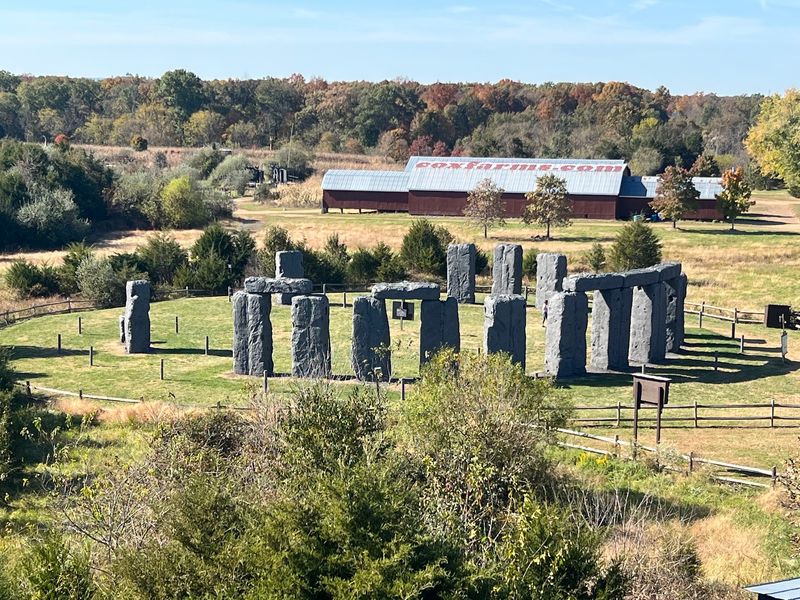
Across an open field, giant gray shapes create a scene that seems borrowed from a much older world. Then comes the surprise: those heavy-looking blocks are foam, not stone. Foamhenge stands at Cox Farms, 15621 Braddock Rd, Centreville, VA 20120, United States.
The attraction copies the famous form of Stonehenge at full scale, giving visitors an unusual meeting of ancient design and modern materials. Its setting adds to the joke, because a familiar farm visit suddenly includes something that looks like a prehistoric monument. You do not need to be a history expert to enjoy that moment.
Before heading out, check the farm’s official website for current access details. Opening times for the wider property do not necessarily mean the sculpture can be visited freely throughout those hours. Seasonal events, transportation arrangements, and admission rules may affect your plans.
Once you arrive, follow staff directions rather than trying to reach the display from a nearby road. Treat it as an attraction within a working visitor property, not an unrestricted roadside stop. That small bit of preparation helps preserve the surprise for the right reason: discovering a strange, clever landmark instead of finding a closed entrance after an unnecessary drive with disappointed passengers in the car.
Giant Blocks That Fool Your Eyes
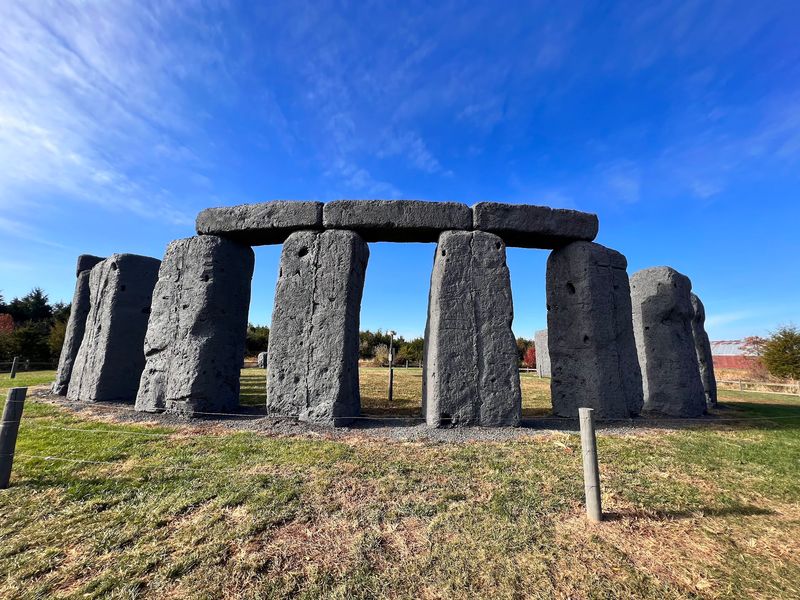
Your eyes say stone, but the material tells a completely different story. The oversized blocks are made from polystyrene foam, a lightweight material often associated with packaging and insulation. Here, it becomes the main ingredient in a convincing outdoor illusion.
Paint and shaped surfaces help the pieces resemble weathered rock rather than fresh foam. Visitors have noticed cracks and dents that make the blocks appear more believable. From a distance, those details blend into the broad gray forms and strengthen the feeling that something ancient stands ahead.
Take a moment to compare the surface with the outline of each upright. The trick works through both texture and scale, not simply because the blocks are painted gray. Large shapes create the first impression, while smaller marks reward a closer look from permitted viewing areas.
Resist any urge to tap a block to test whether it is real. A convincing appearance does not make the sculpture suitable for climbing, leaning, or rough handling. Follow posted boundaries and leave the material undisturbed.
For children, the display offers a simple lesson about observation. Ask what clues suggest stone, then explain how artists can copy those clues with another material. Suddenly, a funny attraction becomes a memorable exercise in looking carefully and questioning assumptions.
An April Fools’ Idea With Staying Power
April Fools’ Day seems like exactly the right birthday for a monument that tricks people into seeing stone. Artist Mark Cline created Foamhenge, and the attraction opened on April 1, 2004. That date fits its cheerful mix of careful craft and a very big visual joke.
Cline is known for unusual creations that turn ordinary outings into unexpected encounters. With this project, the humor comes from replacing massive rock with a material people usually consider light and disposable. The result is silly in concept but impressive enough to make visitors stop and look.
The sculpture later moved, reaching its current home in 2017. That history matters when you read older travel posts or visitor reviews. An account of someone’s original visit may describe access arrangements that no longer apply.
Use the official farm website for practical planning, and treat older stories as background rather than instructions. A roadside attraction can change over time without losing the idea that made it interesting. Foamhenge’s continued appeal rests on that simple contrast between what you expect and what actually stands before you.
Knowing its birthday adds another layer to the visit. You are looking at an artist’s lasting prank, one built big enough to turn a quick double take into a shared memory.
Full Scale Makes the Joke Even Better
A tiny model might earn a smile, but towering uprights make the idea feel wonderfully bold. Foamhenge is described as a full-scale replica, meaning its appeal depends on size as much as its unusual building material. The blocks are meant to suggest a monument, not a tabletop souvenir.
Look for the basic arrangement of standing pieces and horizontal blocks resting above them. Those overhead pieces are called lintels, a useful word for understanding the structure. Together, the shapes create the familiar silhouette that makes the replica recognizable even before someone explains it.
Full scale does not mean the visitor experience matches the ancient original in every way. The materials, age, setting, and purpose are completely different. Enjoy the sculpture as an artistic interpretation rather than expecting the same historical weight or archaeological setting.
Give yourself time to notice how the outlines change from different permitted viewpoints. One angle may emphasize paired uprights, while another brings several lintels into view. That shifting pattern is part of what makes large outdoor sculpture rewarding.
If you are visiting with someone who has never seen images of Stonehenge, show them a reference beforehand. Recognizing the borrowed design makes the foam surprise stronger and helps explain why the joke works at such an enormous scale.
A Little Planning Prevents a Closed-Gate Surprise
A spontaneous stop sounds easy until seasonal access changes the plan. Foamhenge belongs to a larger visitor operation, so checking its specific availability is more useful than relying on a general map listing. Make that check before you leave home, especially when traveling with children.
The supplied listing shows Friday, Saturday, and Sunday hours of 10 a.m. to 7 p.m., with Monday through Thursday closed. However, listed hours can change and may describe broader property operations rather than guaranteed access to the sculpture. Do not treat them as a promise for every season.
Visit coxfarmsva.com for current information, or call 703-830-4121 if the access instructions remain unclear. Ask whether Foamhenge is available on your chosen date, how visitors reach it, and whether admission or an event ticket is required. Those questions are more helpful than simply asking whether the farm is open.
Visitor reviews mention seeing the sculpture during hayrides and seasonal events. That suggests the route can be part of a larger experience, but it does not establish a permanent schedule. Confirm arrangements rather than assuming every ride includes the same stop.
Also check the weather and allow some flexibility. A carefully planned outing leaves room to enjoy the landmark without rushing, guessing, or arguing with outdated directions.
Stonehenge-Style Photos Without the Stone
A camera can turn the foam illusion into an especially convincing souvenir. From the right permitted viewpoint, the gray uprights fill the frame and make the scene look surprisingly monumental. You do not need special equipment to capture the contrast between ordinary surroundings and extraordinary shapes.
Start with a wide picture that shows the overall arrangement. Then try a tighter composition that highlights a few uprights and their lintels. Changing your framing often produces more variety than taking many photographs from exactly the same spot.
Daylight is the safest choice if clear details are your priority. Reviews offer mixed reports about nighttime lighting, with some visitors finding it limited. Rather than expecting a brightly lit display after dark, plan around available natural light whenever access allows.
Keep people outside any marked boundaries, even if moving closer would improve the picture. A visitor standing safely in the foreground can still help show the sculpture’s size. Avoid poses that suggest climbing or touching the blocks.
Before leaving, take one photograph that includes the wider setting. That image preserves the funniest part of the experience: an unexpected ancient-looking structure appearing in a modern outing. The close shots show the artwork, while the broader view tells the story you will remember and share later.
An Easy Conversation Starter for Curious Kids
Some children will laugh at the foam reveal, while others will want to know why anyone built it. Both reactions give adults a useful starting point. The attraction can spark a short conversation about history, materials, and the difference between an original monument and a replica.
Keep the explanation simple: the ancient structure inspired this modern artwork, but these blocks are not ancient stones. A replica copies the appearance of something else. That distinction helps children enjoy the display without confusing a playful sculpture with an archaeological site.
Ask them to describe what they notice before supplying all the answers. They might point out the tall uprights, the blocks across the top, or the rough-looking surfaces. Their observations can lead naturally to the question of how artists make one material resemble another.
Interest levels will vary, and visitor reviews reflect that. Some families describe a useful learning moment, while another reviewer felt younger children might not understand the joke. There is no need to turn every visit into a long lesson.
Let the sculpture be a brief discovery if that suits your group. A few clear facts, a funny photograph, and respect for the viewing rules may be enough. Curiosity often grows best when children have space to enjoy the surprise.
Enjoy the Oddity, Then Leave It Untouched
The best way to appreciate a giant foam monument is also the simplest: look closely and keep your hands off. Its convincing stone appearance can hide the fact that it is still an artwork made from a different material. Respecting the boundaries protects the illusion for future visitors.
Several reviews mention restrictions on approaching or touching the blocks. Exact distances may change, so follow current signs and staff instructions rather than repeating a number from an old review. Never assume a gap in a barrier is an invitation to step closer.
Set realistic expectations for the visit itself. Foamhenge is a distinctive sculpture, not a museum filled with rooms of exhibits. Some people will spend their time studying the details, while others will enjoy a few pictures and move along.
The supplied listing gives it 4.5 stars across 181 reviews, reflecting a generally positive response at that snapshot in time. Ratings and review totals can change, and comments about wider farm activities are not always reviews of the sculpture alone. Read with that difference in mind.
What makes the landmark memorable is its clear, unusual idea. An enormous ancient-looking form turns out to be something wonderfully unexpected. Arrive prepared, enjoy the visual joke, and leave the artwork exactly as you found it.